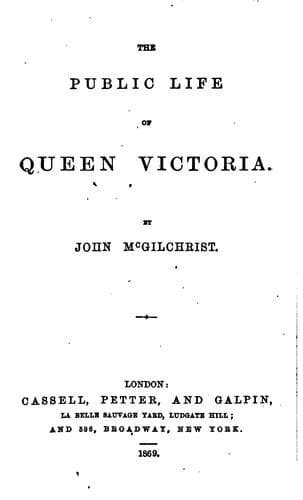
The Public Life of Queen VictoriaMcGilchrist, John
History
The Public Life of Queen Victoria
McGilchrist, John
Victoria, Queen of Great Britain, 1819-1901
The gardens were pedantically squared to Dutch uniformity by William of
Orange, and the semblance of a Court which he held in this Palace was
correspondingly gloomy and dismal. The most singular visitor ever received
by William was the Czar Peter, who drove hither _incognito_ in a hackney
coach, on his arrival in London, and was afterwards entertained here with
some slight show of state. In Anne's time, the palace and gardens were
little livelier than in William's. The Queen hedged herself in behind
absurd _chevaux-de-frise_ of etiquette, and the court chroniclers of the
period record little else than eating and drinking. Swift and Prior,
Bolingbroke and Marlborough, Addison and Steele, nevertheless, lent
occasional gleams of brightness and dignity to the otherwise sombre scene.
The most fascinating and memorable association of Kensington Palace is in
connection with the Courts of the first two Georges, and of the son of the
latter, Frederick Prince of Wales. These associations are specially
connected with the bevies of frolicsome, and sometimes frail, maids of
honour, who now live in the pages of Pope and Gay, of Hervey and Walpole.
Chief among them was the gay, sprightly, and irresistible Molly Leppell,
who resisted, in a manner equally indignant and comical, the degrading
overtures of the coarse-souled George II. She married Hervey, the most
effeminate and egregious dandy of his time. Chesterfield thus toasted her
in a ballad on the beauties of the Court;--
Oh! if I had Bremen and Varden,
And likewise the Duchy of Zell,
I'd part with them all for a farden,
To have my dear Molly Leppell.
Caroline of Anspach, consort of Frederick, Prince of Wales, introduced the
habit of promenading in gorgeous costume in the gardens, first on
Saturday, then on Sunday, afternoons. By degrees the quality were admitted
as well as the royal family and their immediate attendants. The liberty
was gradually extended to the general public. Hence it was that Kensington
Gardens became in time as open to all comers as are the royal parks. These
gorgeous promenades ceased with the commencement of the last malady of
George III. It was in allusion to the stately train of attendant beauties
who accompanied the Princess Caroline of Wales, that Tickell wrote--
Each walk, with robes of various dyes bespread,
Seems from afar a moving tulip bed,
Where rich brocades and glossy damasks glow,
And chintz, the rival of the showery bow.
Here England's Daughter, darling of the land,
Sometimes, surrounded with her virgin band,
Gleams through the shades. She, towering o'er the rest,
Stands fairest of the fairer kind confess'd;
Form'd to gain hearts that Brunswick's cause denied,
And charm a people to her father's side.
Public-domain text, read in full here on John Shaqi.
Reviews
Reviews
No reviews yet
Be the first to share your thoughts on this work.
Join the Discussion
Join the discussion
Sign in to leave a comment or review.
Sign InorCreate an account