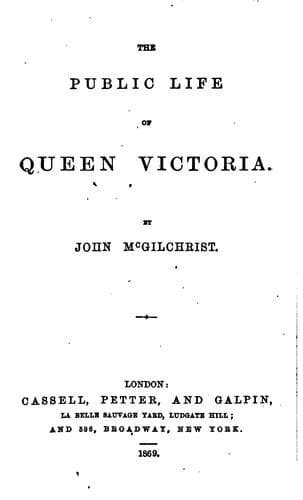
The Public Life of Queen VictoriaMcGilchrist, John
History
The Public Life of Queen Victoria
McGilchrist, John
Victoria, Queen of Great Britain, 1819-1901
clear explanations of the phenomena which evoked her admiration. Her
engrossing passion, indeed--as was that of her future husband--was for
cabinets of natural history, menageries, museums, &c. For pictures she had
an equal love, and one of the first acquirements in which she became
proficient was sketching from nature.
Perhaps the greatest danger she incurred, and the one which her mother had
to take the greatest pains to avert, was the likelihood that her
independent decision of character, which she derived from the Hanoverian
half of her ancestry, might degenerate into stubbornness and self-will.
But her natural sense of justice, and ready openness to clear conviction,
proved an admirable counterpoise. With peculiar ingenuousness of
character, she unreservedly admitted an error the very instant she
perceived it. Once, for example, when on a visit to Earl Fitzwilliam, a
bosom friend of her father, the party were walking in the grounds, and she
had run on in advance. An under-gardener cautioned her not to go down a
certain walk, as, said he, in his provincial dialect, the rain had made
the ground "slape." "Slape! slape!" cried she, rapidly, and in the true
George III. style; "and pray, what is 'slape?'" "Very slippery, miss--your
Royal Highness--ma'am," replied he. "Oh! that's all," she replied; "thank
you," and at once proceeded. She had not advanced many yards, when she
came down heavily to the ground. The Earl had been observing all that had
passed, from a few yards' distance, and he cried out, "There! now your
Royal Highness has an explanation of the term 'slape,' both theoretically
and practically." "Yes, my lord," she somewhat meekly said, "I think I
have. I shall never forget the word 'slape.'" On a similar occasion, when
cautioned not to frolic with a dog whose temper was not very reliable, she
persisted in doing so, and he made a snap at her hand. Her cautioner ran
solicitously, believing that she had been bitten. "Oh, thank you! thank
you!" said she. "You're right, and I am wrong; but he didn't bite me--he
only warned me. I shall be careful in future."
[Sidenote: JUVENILE ANECDOTES.]
The following incident shows that at least on some occasions a keen spirit
of waggishness entered strongly into her self-will. When first she took
lessons on the piano, she objected strongly to the monotonous fingering,
as she had formerly done to A B C. She was, of course, informed that all
success as a musician depended upon her first becoming "mistress of the
piano."
"Oh, I am to be mistress of my piano, am I?" asked she. To that the reply
was a repetition of the statement.
"Then what would you think of me if I became mistress at once?"
"That would be impossible. There is no royal road to music. Experience and
great practice are essential."
Public-domain text, read in full here on John Shaqi.
Reviews
Reviews
No reviews yet
Be the first to share your thoughts on this work.
Join the Discussion
Join the discussion
Sign in to leave a comment or review.
Sign InorCreate an account