RUFE MELTON came home to find life not the same. Matters had evolved
while he was away about his country’s business, matters that didn’t
please him now. He had rushed to Pidge. As the steamer approached
New York, a novel and unforeseen eagerness awoke within to get to
her, but she hadn’t put off her Arctics. Besides, off duty from her
editorial job, there was an infant in her arms for the most part--a
seven-months-old male infant with combed hair, that had looked into his
face and begun to yell. Rufe took this as a personal affront. He had
supposed it hers at first.
“Sometimes, I forget that it isn’t,” she had said.
Harrow Street furnished the statement and proof, however, that it was
Fanny Gallup’s, who was dead.
“But why don’t you adopt the other two?” he asked.
“Miss Claes has found homes for Albert’s children,” Pidge said.
Rufe stood it for two days. “This can’t go on, Pan. I’ve got to get to
work--no nerves to work in this racket, since I was gassed----”
“Of course not.”
Under his surface anger, she saw the old look of hurt wonder that
harrowed her so.
“Come back--any time, Rufe--come whenever you can. Always a place here,
you know.”
XXXVII
JOHN HIGGINS’ CODE
WHEN Dicky Cobden reached New York, he found that Pidge had been
called to Los Angeles, because her father was ill. It was an evening
in mid-January, 1919, and he went at once to his mother’s house in
Fiftieth Street. The strain of waiting for his home-coming had been
almost too much there. Grandfather had flickered out; his bed and
chairs gaped and would not be comforted. Dicky went into the living
arms, however, and found rest and gave it. His mother and aunt and
sister livened up like plants, newly-watered. He was queerly astonished
to learn that Pidge recently had called upon his people--“just a social
call,” his mother said.
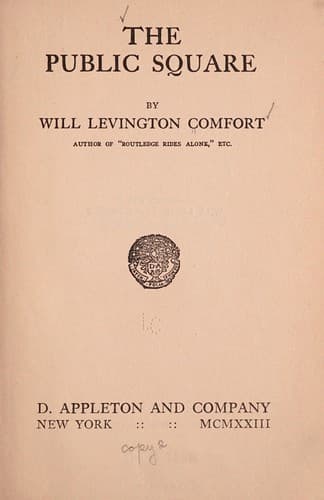
Outwardly things looked as hopeless as possible at _The Public Square_.
From his latest retirement to his rooms for a change of luck, John
Higgins had been taken to the hospital, instead of returning to his
desk. It was a gray-faced old man that Dicky found in the early morning
of his first full day at home, in a room that smelled of drugs. The
face didn’t look at him squarely. The light hurt John Higgins’ eyes
and made the features writhe. Dicky wanted to move around to the other
side of the bed, so the face would be shaded, but his old friend was
gripping him with both hands.
“We have been looking for you a long time, Dicky,” he kept saying.
It wasn’t the unshaven white stubble that changed the face so much as
the quiver of the upper lip, when John Higgins spoke.
“What’s the matter, John?”
“Indigestion--all kinds of indigestion. Damn ’em, Dicky, they’ve made
me eat my own words----”
“Who?”
“The most pestiferous public nuisance ever organized--Department of
Justice.”
Dicky did not need to be warned against the _bête noir_. Its shadow was
upon John Higgins’ face.
Public-domain text, read in full here on John Shaqi.
Reviews
Reviews
No reviews yet
Be the first to share your thoughts on this work.
Elsewhere in the archive
Join the Discussion
Join the discussion
Sign in to leave a comment or review.
Sign InorCreate an account