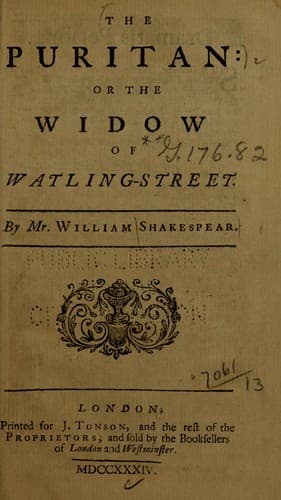
English drama -- Early modern and Elizabethan, 1500-1600; Shakespeare, William, 1564-1616 -- Spurious and doubtful works
THE PURITAINE WIDDOW
THE
ACTORS
NAME
In the Play Intitled
The Puritan Widow.
The Scene London.
Lady Plus, a Citizens Widow.
Frances,
Moll, her two Daughters.
Sir Godfrey, Brother-in-Law to the Widow Plus.
Master Edmond, Son to the Widow Plus.
George Pye-boord, a Scholar and a Citizen.
Peter Skirmish, an old Soldier.
Captain Idle, a Highway-man.
Corporal Oath, a vain-glorious Fellow.
Nichols St. Antlings,
Simon St. Mary Overies,
Frailty, Serving-men to the Lady Plus.
Sir Oliver Muck-hill, a Suitor to the Lady Plus.
Sir John Penny-Dub, a Suitor to Moll.
Sir Andrew Tipstaff, a Suitor to Frances.
The Sheriff of London.
Puttock,
Ravenshaw, Two of the Sheriffs Sergeants.
Dogson, a Yeoman.
A Noble-man.
A Gentleman Citizen.
Officers.
ACTUS PRIMUS.
Scene I. A Garden behind the widow’s house.
[Enter the Lady Widdow-Plus, her two daughters Frank and Moll,
her husband’s Brother an old Knight Sir Godfrey, with her Son
and heir Master Edmond, all in mourning apparel, Edmond in a
Cyrpess Hat. The Widdow wringing her hands, and bursting out
Into passion, as newly come from the Burial of her husband.
WIDOW.
Oh, that ever I was borne, that ever I was borne!
SIR GODFREY.
Nay, good Sister, dear sister, sweet sister, be of good
comfort; show your self a woman, now or never.
WIDOW.
Oh, I have lost the dearest man, I have buried the sweetest
husband that ever lay by woman.
SIR GODFREY.
Nay, give him his due, he was indeed an honest, virtuous,
Discreet, wise man,—he was my Brother, as right as right.
WIDOW.
O, I shall never forget him, never forget him; he was a man
so well given to a woman—oh!
SIR GODFREY.
Nay, but, kind Sister, I could weep as much as any woman,
but, alas, our tears cannot call him again: me thinks you
are well read, Sister, and know that death is as common as
Homo, a common name to all men:—a man shall be taken when
he’s making water.—Nay, did not the learned Parson, Master
Pigman, tell us e’en now, that all Flesh is frail, we are
borne to die, Man ha’s but a time: with such like deep and
profound persuasions, as he is a rare fellow, you know, and
an excellent Reader: and for example, (as there are
examples aboundance,) did not Sir Humfrey Bubble die tother
day? There’s a lusty Widdow; why, she cried not above half
an hour—for shame, for shame! Then followed him old Master
Fulsome, the Usurer: there’s a wise Widdow; why, she cried
ne’er a whit at all.
WIDOW.
O, rank not me with those wicked women: I had a husband
Out-shined ’em all.
SIR GODFREY.
Aye, that he did, yfaith: he out-shined ’em all.
WIDOW.
Doost thou stand there and see us all weep, and not once
shed a tear for thy father’s death? oh, thou ungratious son
and heir, thou!
EDMOND.
Troth, Mother, I should not weep, I’m sure; I am past a
child, I hope, to make all my old School fellows laugh at
me; I should be mocked, so I should. Pray, let one of my
Sisters weep for me. I’ll laugh as much for her another
time.
Public-domain text, read in full here on John Shaqi.
Reviews
Reviews
No reviews yet
Be the first to share your thoughts on this work.
Join the Discussion
Join the discussion
Sign in to leave a comment or review.
Sign InorCreate an account