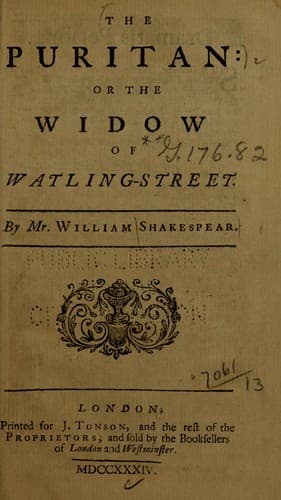
English drama -- Early modern and Elizabethan, 1500-1600; Shakespeare, William, 1564-1616 -- Spurious and doubtful works
WIDOW.
Oh, thou past-Grace, thou! out of my sight, thou graceless
imp, thou grievest me more than the death of thy Father! oh,
thou stubborn only son! hadst thou such an honest man to thy
Father—that would deceive all the world to get riches for
thee—and canst thou not afford a little salt water? he that
so wisely did quite over-throw the right heir of those lands,
which now you respect not: up every morning betwixt four
and five; so duly at Westminster Hall every Term-Time, with
all his Cards and writings, for thee, thou wicked Absolon—
oh, dear husband!
EDMOND.
Weep, quotha? I protest I am glad he’s Churched; for now
he’s gone, I shall spend in quiet.
FRANCES.
Dear mother, pray cease; half your Tears suffice.
Tis time for you to take truce with your eyes;
Let me weep now.
WIDOW.
Oh, such a dear knight! such a sweet husband have I lost,
have I lost!—If Blessed be the coarse the rain rains upon,
he had it pouring down.
SIR GODFREY.
Sister, be of good cheer, we are all mortal our selves. I
come upon you freshly. I near speak without comfort, hear
me what I shall say:—my brother ha’s left you wealthy,
y’are rich.
WIDOW.
Oh!
SIR GODFREY.
I say y’are rich: you are also fair.
WIDOW.
Oh!
SIR GODFREY.
Go to, y’are fair, you cannot smother it; beauty will come
to light; nor are your years so far enter’d with you, but
that you will be sought after, and may very well answer
another husband; the world is full of fine Gallants, choice
enow, Sister,—for what should we do with all our Knights,
I pray, but to marry rich widows, wealthy Citizens’ widows,
lusty fair-browed Ladies? go to, be of good comfort, I say:
leave snobbing and weeping—Yet my Brother was a kind hearted
man—I would not have the Elf see me now!—Come, pluck up a
woman’s heart—here stands your Daughters, who be well
estated, and at maturity will also be enquir’d after with
good husbands, so all these tears shall be soon dried up and
a better world than ever—What, Woman? you must not weep
still; he’s dead, he’s buried—yet I cannot choose but weep
for him!
WIDOW.
Marry again! no! let me be buried quick then!
And that same part of Quire whereon I tread
To such intent, O may it be my grave;
And that the priest may turn his wedding prayers,
E’en with a breath, to funeral dust and ashes!
Oh, out of a million of millions, I should ne’er find such
a husband; he was unmatchable,—unmatchable! nothing was
too hot, nor too dear for me, I could not speak of that
one thing, that I had not: beside I had keys of all, kept
all, receiv’d all, had money in my purse, spent what I would,
came home when I would, and did all what I would. Oh, my
sweet husband! I shall never have the like.
SIR GODFREY.
Sister, ne’er say so; he was an honest brother of mine, and
so, and you may light upon one as honest again, or one as
honest again may light upon you: that’s the properer
phrase, indeed.
WIDOW.
Never! Oh, if you love me, urge it not.
[Kneels.]
Public-domain text, read in full here on John Shaqi.
Reviews
Reviews
No reviews yet
Be the first to share your thoughts on this work.
Join the Discussion
Join the discussion
Sign in to leave a comment or review.
Sign InorCreate an account