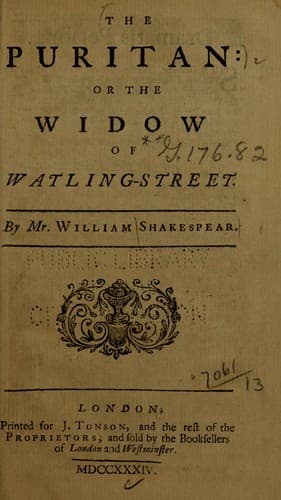
English drama -- Early modern and Elizabethan, 1500-1600; Shakespeare, William, 1564-1616 -- Spurious and doubtful works
How now, Simon? where’s my son Edmund?
SIMON.
Verily Madame, he is at vain Exercise, dripping in the
Tennis-court.
WIDDOW.
At Tennis-court? oh, now his father’s gone, I shall have no
rule with him; oh, wicked Edmond, I might well compare this
with the Prophecy in the Chronicle, tho far inferior: as
Harry of Monmouth won all, and Harry of Windsor lost all;
so Edmund of Bristow, that was the Father, got all, and
Edmond of London, that’s his son now, will spend all.
SIR GODFREY.
Peace, Sister, we’ll have him reformed, there’s hope on him
yet, tho it be but a little.
[Enter Frailty.]
FRAILTY.
Forsooth, Madam, there are two or three Archers at door
would very gladly speak with your Ladyship.
WIDDOW.
Archers?
SIR GODFREY.
Your husband’s Fletcher, I warrant.
WIDDOW.
Oh!
Let them come near, they bring home things of his.
Troth, I should ha forgot ’em. How now, Villain?
Which be those Archers?
[Enter the suitors Sir Andrew Tip-staff, Sir Oliver Muck-hill,
and Penny-dub.]
FRAILTY.
Why, do you not see ’em before you? are not these Archers?
what do you call ’em? Shooters: Shooters and Archers are
all one, I hope.
WIDDOW.
Out, ignorant slave.
MUCK-HILL.
Nay, pray be patient, Lady,
We come in way of honorable love.
TIP-STAFF.
We do.
PENNY-DUB.
We do.
MUCK-HILL.
To you.
TIP-STAFF.
And to your Daughters.
PENNY-DUB.
And to your Daughters.
WIDDOW.
O, why will you offer me this Gentlemen? indeed I will not
look upon you—when the Tears are scarce out of mine Eyes,
not yet washt off from my Cheeks, and my deer husband’s body
scarce so cold as the Coffin, what reason have you to offer
it? I am not like some of your Widdows that will bury one
in the Evening, and be sure to another ere morning. Pray,
away; pray, take your answers, good Knights, and you be sweet
Knights. I have vow’d never to marry;—and so have my
daughters too!
PENNY-DUB.
Aye, two of you have, but the third’s a good wench!
MUCK-HILL.
Lady, a shrewd answer, marry; the best is, tis but the first,
and he’s a blunt wooer, that will leave for one sharp answer.
TIP-STAFF.
Where be your daughters, Lady? I hope they’ll give us better
encouragements.
WIDDOW.
Indeed, they’ll answer you so; tak’t a my word, they’ll give
you the very same answer Verbatim, truly la.
PENNY-DUB.
Mum: Moll’s a good wench still, I know what she’ll do.
MUCK-HILL.
Well, Lady, for this time we’ll take our leaves, hoping for
better comfort.
WIDDOW.
O never, never! and I live these thousand years! and you be
good Knights, do not hope; twill be all Vain, Vain,—look
you, put off all your suits, and you come to me again.
[Exeunt Sir John and Sir Andrew.]
FRAILTY.
Put off all their suits, quatha? Aye, that’s the best
wooing of a Widdow, indeed, when a man’s Nonsuited; that is,
when he’s a bed with her.
[Going out, Muck-hill and Sir Godfrey.]
MUCK-HILL.
Sir Godfrey, here’s twenty Angels more: work hard for me;
there’s life int yet.
[Exit Muck-hill.]
Public-domain text, read in full here on John Shaqi.
Reviews
Reviews
No reviews yet
Be the first to share your thoughts on this work.
Join the Discussion
Join the discussion
Sign in to leave a comment or review.
Sign InorCreate an account