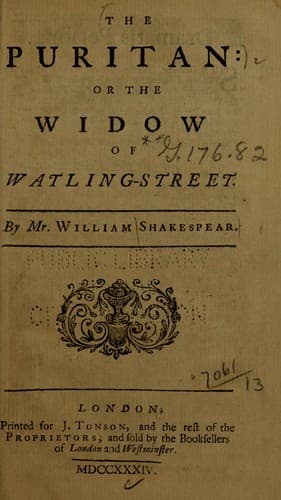
English drama -- Early modern and Elizabethan, 1500-1600; Shakespeare, William, 1564-1616 -- Spurious and doubtful works
PYE.
The Devil of conjuring? Nay, by my fay, I’d not have thee
do so much, Captain, as the Devil a conjuring: look here,
I ha brought thee a circle ready charactered and all.
CAPTAIN.
Sfoot, George, art in thy right wits? doost know what
thou sayest? why doost talk to a Captain of conjuring?
didst thou ever hear of a Captain conjure in thy life?
doost cal’t a Circle? tis too wide a thing, me thinks:
had it been a lesser Circle, then I knew what to have done.
PYE.
Why, every fool knows that, Captain: nay, then, I’ll not
cog with you, Captain; if you’ll stay and hang the next
Sessions, you may.
CAPTAIN.
No, by my faith, George: come, come, let’s to conjuring,
let’s to conjuring.
PYE.
But if you look to be released—as my wits have took
pain to work it, and all means wrought to farther it—
besides to put crowns in your purse, to make you a man
of better hopes, and whereas before you were a Captain
or poor Soldier, to make you now a Commander of rich fools,
(which is truly the only best purchase peace can allow
you) safer then High-ways, Heath, or Cunny-groves, and
yet a far better booty; for your greatest thieves are
never hangd, never hangd, for, why, they’re wise, and
cheat within doors: and we geld fools of more money in
one night, then your false tailed Gelding will purchase
in a twelve-month’s running; which confirms the old Beldam
saying, he’s wisest, that keeps himself warmest; that is,
he that robs by a good fire—
CAPTAIN.
Well opened, yfaith, George; thou has pulled that saying
out of the husk.
PYE.
Captain Idle, tis no time now to delude or delay: the old
Knight will be here suddenly. I’ll perfect you, direct
you, tell you the trick on’t: tis nothing.
CAPTAIN.
Sfoot, George, I know not what to say toot: conjure? I
shall be hand ere I conjure.
PYE.
Nay, tell not me of that, Captain; you’ll ne’er conjure
after you’re hangd, I warrant you. Look you, sir, a parlous
matter, sure! First, to spread your circle upon the ground,
then, with a little conjuring ceremony, as I’ll have an
Hackney-man’s wand silvered ore a purpose for you,—then
arriving in the circle, with a huge word, and a great
trample, as for instance:—have you never seen a stalking-
stamping Player, that will raise a tempest with his tongue,
and thunder with his heels?
CAPTAIN.
O yes, yes, yes: often, often.
PYE.
Why, be like such a one, for any thing will blear the old
Knight’s eyes: for you must note that he’ll ne’er dare to
venture into the room, only perhaps peep fearfully through
the Key hold, to see how the Play goes forward.
CAPTAIN.
Well, I may go about it when I will, but mark the end ont:
I shall but shame my self, ifaith, George. Speak big words,
and stamp and stare, and he look in at Key-hold! why, the
very thought of that would make me laugh out-right, and
spoil all: nay, I’ll tell thee, George, when I apprehend
a thing once, I am of such a laxative laughter, that if the
Devil him-self stood by, I should laugh in his face.
Public-domain text, read in full here on John Shaqi.
Reviews
Reviews
No reviews yet
Be the first to share your thoughts on this work.
Join the Discussion
Join the discussion
Sign in to leave a comment or review.
Sign InorCreate an account