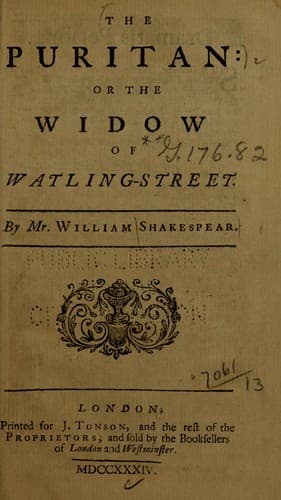
English drama -- Early modern and Elizabethan, 1500-1600; Shakespeare, William, 1564-1616 -- Spurious and doubtful works
PYE.
Puh, that’s but the babe of a man, and may easily be husht;
as to think upon some disaster, some sad misfortune, as the
death of thy Father ithe Country!
CAPTAIN.
Sfoot, that would be the more to drive me into such an
extasy, that I should ne’er lin laughing.
PYE.
Why, then, think upon going to hanging else.
CAPTAIN.
Mass, that’s well remembred; now I’ll do well, I warrant
thee, ne’er fear me now: but how shall I do, George, for
boisterous words, and horrible names?
PYE.
Puh, any fustian invocations, Captain, will serve as well
as the best, so you rant them out well; or you may go to a
Pothecaries shop, and take all the words from the Boxes.
CAPTAIN.
Troth, and you say true, George; there’s strange words
enow to raise a hundred Quack-salvers, tho they be ne’er
so poor when they begin. But here lies the fear on’t, how
if in this false conjuration, a true Devil should pop up
indeed?
PYE.
A true Devil, Captain? why there was ne’er such a one: nay,
faith, he that has this place is as false a Knave as our
last Church-warden.
CAPTAIN.
Then he’s false enough a conscience, ifaith, George.
[The Crie at Marshalsea.]
CRIE PRISONERS.
Good Gentlemen over the way, send your relief. Good
Gentlemen over the way,—Good sir Godfrey!
PYE.
He’s come, he’s come.
NICHOLAS.
Master, that’s my Kinsman yonder in the Buff-jerkin—Kinsman,
that’s my Master yonder ith’ Taffetie Hat—pray salute him
entirely!
[They salute: and Pye-board salutes Master Edmond.]
SIR GODFREY.
Now, my friend.
PYE.
May I pertake your name, sir?
EDMOND.
My name is Master Edmond.
PYE.
Master Edmond?—are you not a Welshman, sir?
EDMOND.
A Welshman? why?
PYE.
Because Master is your Christian name, and Edmond your
sir name.
EDMOND.
O no; I have more names at home: Master Edmond Plus is my
full name at length.
PYE.
O, cry you mercy, sir. [Whispering]
CAPTAIN.
I understand that you are my Kinsman’s good Master, and in
regard of that, the best of my skill is at your service:
but had you fortuned a mere stranger, and made no means to
me by acquaintance, I should have utterly denied to have
been the man; both by reason of the act past in Parliament
against Conjurers and Witches, as also, because I would not
have my Art vulgar, trite, and common.
SIR GODFREY.
I much commend your care therein, good Captain Conjurer,
and that I will be sure to have it private enough, you
shall doot in my Sister’s house,—mine own house, I may
call it, for both our charges therein are proportioned.
CAPTAIN.
Very good, sir—what may I call your loss, sir?
SIR GODFREY.
O you may call’t a great loss, sir, a grievous loss, sir;
as goodly a Chain of gold, tho I say it, that wore it: how
sayest thou, Nicholas?
NICHOLAS.
O ’twas as delicious a Chain a Gold! Kinsman, you know,—
SIR GODFREY.
You know? did you know’t, Captain?
CAPTAIN.
Trust a fool with secrets!—Sir, he may say I know: his
meaning is, because my Art is such, that by it I may gather
a knowledge of all things.
SIR GODFREY.
Aye, very true.
Public-domain text, read in full here on John Shaqi.
Reviews
Reviews
No reviews yet
Be the first to share your thoughts on this work.
Join the Discussion
Join the discussion
Sign in to leave a comment or review.
Sign InorCreate an account