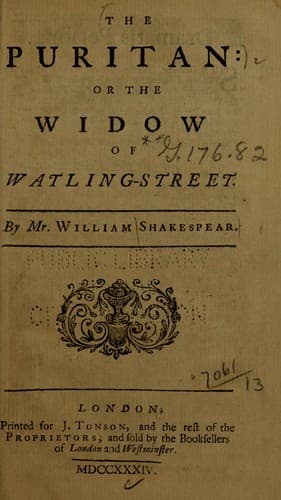
English drama -- Early modern and Elizabethan, 1500-1600; Shakespeare, William, 1564-1616 -- Spurious and doubtful works
CAPTAIN.
Who, he? he’s a rare friend of mine, an admirable fellow,
Knight, the finest fortune-teller.
SIR GODFREY.
Oh, tis he indeed that came to my Lady sister, and foretold
the loss of my chain. I am not angry with him now, for I
see twas my fortune to loose it.—By your leave, Master
Fortune-teller, I had a glimpse on you at home at my
Sisters the Widdows, there you prophesied of the loss of a
chain:—simply tho I stand here, I was he that lost it.
PYE.
Was it you, sir?
EDMOND.
A my troth, Nuckle, he’s the rarest fellow: has told me my
fortune so right; I find it so right to my nature.
SIR GODFREY.
What ist? God send it a good one!
EDMOND.
O, tis a passing good one, Nuncle: for he says I shall prove
such an excellent gamester in my time, that I shall spend
all faster then my father got it.
SIR GODFREY.
There’s a fortune, in deed!
EDMOND.
Nay, it hits my humour so pat.
SIR GODFREY.
Aye, that will be the end ont: will the Curse of the beggar
prevail so much, that the son shall consume that foolishly,
which the father got craftily? Aye, aye, aye; twill, twill,
twill.
PYE.
Stay, stay, stay.
[Pye-board with an Almanack and the Captain.]
CAPTAIN.
Turn over, George.
PYE.
June—July: here, July; that’s this month. Sunday thirteen,
yester day forteen, to day fifteen.
CAPTAIN.
Look quickly for the fifteen day:—if within the compass of
these two days there would be some Boystrous storm or other,
it would be the best, I’d defer him off till then: some
tempest, and it be thy will.
PYE.
Here’s the fifteen day—hot and fair.
CAPTAIN.
Puh, would t’ad been hot and foul.
PYE.
The sixteen day; that’s to morrow: the morning for the most
part fair and pleasant—
CAPTAIN.
No luck.
PYE.
But about high-noon, lightning and thunder.
CAPTAIN.
Lightning and thunder! admirable, best of all: I’ll conjure
to morrow just at high noon, George.
PYE.
Happen but true to morrow, Almanack, and I’ll give thee
leave to lie all the year after.
CAPTAIN.
Sir, I must crave your patience, to bestow this day upon
me, that I may furnish my self strongly. I sent a spirit
into Lancashire tother day, to fetch back a knave Drover,
and I look for his return this evening. To morrow morning
my friend here and I will come and break-fast with you.
SIR GODFREY.
Oh, you shall be both most welcome.
CAPTAIN.
And about Noon, without fail, I purpose to conjure.
SIR GODFREY.
Mid noon will be a fine time for you.
EDMOND.
Conjuring! do you mean to conjure at our house to morrow,
sir?
CAPTAIN.
Marry, do I, sir: tis my intent, young Gentleman.
EDMOND.
By my troth, I’ll love you while I live fort. O rare,
Nicholas, we shall have conjuring to morrow.
NICHOLAS.
Puh! Aye, I could ha told you of that.
CAPTAIN.
Law, he could ha told him of that! fool, cockscomb, could
ye?
EDMOND.
Do you hear me, sir? I desire more acquaintance on you:
you shall earn some money of me, now I know you can conjure;
but can you fetch any that is lost?
CAPTAIN.
Oh, any thing that’s lost.
Public-domain text, read in full here on John Shaqi.
Reviews
Reviews
No reviews yet
Be the first to share your thoughts on this work.
Join the Discussion
Join the discussion
Sign in to leave a comment or review.
Sign InorCreate an account