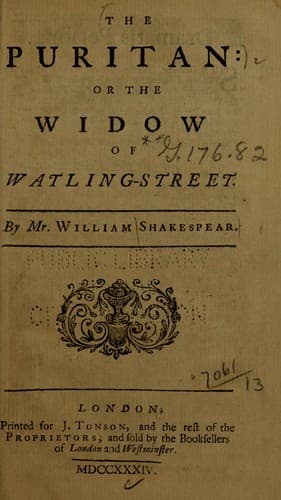
English drama -- Early modern and Elizabethan, 1500-1600; Shakespeare, William, 1564-1616 -- Spurious and doubtful works
Oh may I be the by-word of the world,
The common talk at Table in the mouth
Of every Groom and Waiter, if e’er more
I entertain the carnal suite of Man!
MOLL.
I must kneel down for fashion too.
FRANCES.
And I, whom never man as yet hath scald,
E’ev in this depth of general sorrow, vow
Never to marry, to sustain such loss
As a dear husband seems to be, once dead.
MOLL.
I lov’d my father well, too; but to say,
Nay, vow, I would not marry for his death—
Sure, I should speak false Latin, should I not?
I’d as soon vow never to come in Bed.
Tut! Women must live by th’ quick, and not by th’ dead.
WIDOW.
Dar Copy of my husband, oh let me kiss thee.
How like is this Model! This brief Picture
[Drawing out her husband’s Picture.]
Quickens my tears: my sorrows are renew’d
At this fresh sight.
SIR GODFREY.
Sister—
WIDOW.
Away,
All honesty with him is turn’d to clay.
Oh my sweet husband, oh—
FRANCES.
My dear father!
[Exeunt mother and Frances.]
MOLL.
Here’s a pulling, indeed! I think my Mother weeps for all
the women that ever buried husbands; for if from time to
time all the Widowers’ tears in England had been bottled
up, I do not think all would have filled a three-half-penny
Bottle. Alas, a small matter bucks a hand-kercher,—and
sometimes the spittle stands to nie Saint Thomas a Watrings.
Well, I can mourn in good sober sort as well as another;
but where I spend one tear for a dead Father, I could give
twenty kisses for a quick husband.
[Exit Moll.]
SIR GODFREY.
Well, go thy ways, old Sir Godfrey, and thou mayest be
proud on’t, thou hast a kind loving sister-in-law; how
constant! how passionate! how full of April the poor soul’s
eyes are! Well, I would my Brother knew on’t, he would
then know what a kind wife he had left behind him: truth,
and twere not for shame that the Neighbours at th’ next
garden should hear me, between joy and grief I should e’en
cry out-right!
[Exit Sir Godfrey.]
EDMOND.
So, a fair riddance! My father’s laid in dust; his Coffin
and he is like a whole-meat-pye, and the worms will cut
him up shortly. Farewell, old Dad, farewell. I’ll be
curb’d in no more. I perceived a son and heir may quickly
be made a fool, and he will be one, but I’ll take another
order.—Now she would have me weep for him, for-sooth, and
why? because he cozn’d the right heir, being a fool, and
bestow’d those Lands upon me his eldest Son; and therefore
I must weep for him, ha, ha. Why, all the world knows, as
long as twas his pleasure to get me, twas his duty to get
for me: I know the law in that point; no Attorney can
gull me. Well, my Uncle is an old Ass, and an Admirable
Cockscomb. I’ll rule the Roast my self. I’ll be kept
under no more; I know what I may do well enough by my
Father’s Copy: the Law’s in mine own hands now: nay, now
I know my strength, I’ll be strong enough for my Mother,
I warrant you.
[Exit.]
SCENE II. A street.
[Enter George Pye-board, a scholar and a Citizen, and unto
him an old soldier, Peter Skirmish.]
Public-domain text, read in full here on John Shaqi.
Reviews
Reviews
No reviews yet
Be the first to share your thoughts on this work.
Join the Discussion
Join the discussion
Sign in to leave a comment or review.
Sign InorCreate an account