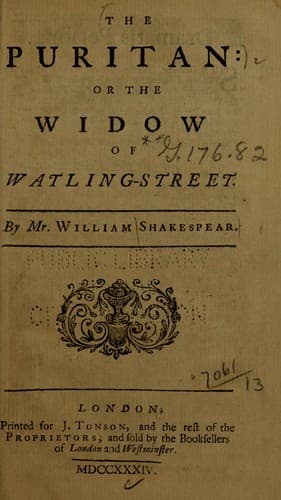
English drama -- Early modern and Elizabethan, 1500-1600; Shakespeare, William, 1564-1616 -- Spurious and doubtful works
EDMOND.
What, you could not? make me walk invisible, man! I should
laugh at that, ifaith; troth, I’ll requite your kindness and
you’ll do’t, good Captain conjurer.
CAPTAIN.
Nay, I should hardly deny you such a small kindness, Master
Edmond Plus: why, look you, sir, tis no more but this and thus
and again, and now yar invisible!
EDMOND.
Am I, ifaith? who would think it?
CAPTAIN.
You see the fortune-teller yonder at farder end ath chamber:
go toward him, do what you will with him; he shall ne’er find
you.
EDMOND.
Say you so? I’ll try that, ifaith,—
[Justles him.]
PYE.
How now? Captain, who’s that justled me?
CAPTAIN.
Justled you? I saw no body.
EDMOND.
Ha, ha, ha!—say twas a spirit.
CAPTAIN.
Shall I?—may be some spirit that haunts the circle.
[Edmond pulls him by the Nose.]
PYE.
O my nose again! pray conjure then, Captain.
EDMOND.
Troth, this is exlent; I may do any knavery now and never be
Seen,—and now I remember me, Sir Godfrey my Uncle abused me
Tother day, and told tales of me to my Mother—Troth, now I’m
Invisible, I’ll hit him a sound wherrit ath’ ear, when he
comes out ath’ garden.—I may be revengd on him now finely.
[Enter Sir Godfrey, Widdow, Frances, Nicholas with the Chain.]
SIR GODFREY.
I have my Chain again, my Chain’s found again. O sweet
Captain, O admirable Conjurer. [Edmond strikes him.] Oh!
what mean you by that, Nephew?
EDMOND.
Nephew? I hope you do not know me, Uncle?
WIDOW.
Why did you strike your Uncle, sir?
EDMOND.
Why, Captain, am I not invisible?
CAPTAIN.
A good jest, George!—not now you are not, Sir.
Why, did you not see me when I did uncharm you?
EDMOND.
Not I by my troth, Captain. Then pray you pardon me, Uncle;
I thought I’d been invisible when I struck you.
SIR GODFREY.
So, you would doo’t? go,—y’are a foolish Boy,
And were I not o’er-come with greater joy,
I’d make you taste correction.
EDMOND.
Correction, push!—no, neither you nor my Mother shall think
to whip me as you have done.
SIR GODFREY.
Captain, my joy is such, I know not how to thank you: let me
embrace you, hug you. O my sweet Chain! Gladness ’een makes
me giddy. Rare man! twas as just ith’ Rosemary bank, as if
one should ha’ laid it there—oh, cunning, cunning!
WIDOW.
Well, seeing my fortune tells me I must marry, let me marry
a man of wit, a man of parts. Here’s a worthy Captain, and
’tis a fine Title truly la to be a Captain’s Wife. A Captain’s
Wife, it goes very finely; beside all the world knows that a
worthy Captain is a fit Companion to any Lord, then why not a
sweet bed-fellow for any Lady,—I’ll have it so—
[Enter Frailty.]
FRAILTY.
O Mistress, Gentlemen, there’s the bravest sight coming along
this way.
WIDOW.
What brave sight?
FRAILTY.
Oh, one going to burying, & another going to hanging.
WIDOW.
A rueful sight.
Public-domain text, read in full here on John Shaqi.
Reviews
Reviews
No reviews yet
Be the first to share your thoughts on this work.
Join the Discussion
Join the discussion
Sign in to leave a comment or review.
Sign InorCreate an account