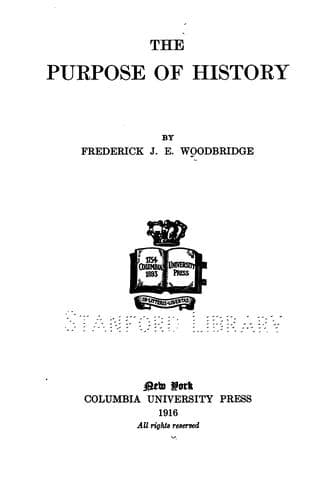
The Purpose of HistoryWoodbridge, Frederick James Eugene
Philosophy
The Purpose of History
Woodbridge, Frederick James Eugene
History -- Philosophy
There are, doubtless, difficulties in thinking of time in this way, for
it is not entirely free from spatial reminiscences. But it serves to
point out that past, present, and future are not like parts of a whole
into which an absolute or complete time is divided. They are more like
derivatives of the time process itself in the concrete instances of its
activity. They are what every growing or changing thing involves,
whether it be the knowledge of man or the crust of the earth, for
everything that grows or changes manufactures a past by realizing a
future. It leaves behind it the record of what it has done conserved by
memory or by nature, and in leaving that record behind constantly
enlarges or transforms it. The growth moves in a manner and an order
which when once performed are unalterable, but there is growth none the
less. Since time is like this, it seems evidently unintelligible to
restrict it and history to human experience and make the world in itself
absolute. It would be better to say that it is history in the large
sense applicable to the world itself that makes human experience
possible. Yet it would be more advisable not to make such a distinction
at all, but to recognize that human experience is one kind of history,
namely, history conscious of itself, the time process deliberately at
work.
Now it is evident that history in this latter sense is purposive and
selective. That which has happened is not remembered as a whole or
understood as a whole. Not only are details forgotten or neglected, but
things and events otherwise important are omitted for the sake of
securing emphasis and distinction among the things remembered. Herodotus
spoke of "wonderful deeds" and others following this example have
regarded history as concerned only with great men and great events. It
is true that the little men and the little events tend to disappear, but
we should remember that it is the selective character of history which
makes them little. Speaking absolutely, we may say that no item, however
apparently insignificant, is really insignificant in the historical
development of any people or any institution, for in some measure every
item is material to that development. But all are not equally material.
The absence of any one of them might undoubtedly have changed the whole
history, but given the presence of them all, some are of greater
significance than others.
Public-domain text, read in full here on John Shaqi.
Reviews
Reviews
No reviews yet
Be the first to share your thoughts on this work.
Join the Discussion
Join the discussion
Sign in to leave a comment or review.
Sign InorCreate an account