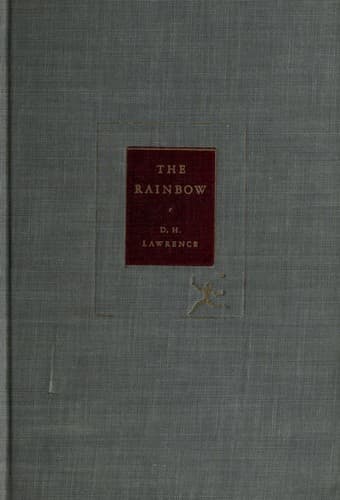
Domestic fiction; Family -- England -- Midlands -- Fiction; Midlands (England) -- Fiction
He turned to the dogs, or to the child if she was there. The little
Anna played about the farm, flitting constantly in to call something to
her mother, to fling her arms round her mother’s skirts, to be noticed,
perhaps caressed, then, forgetting, to slip out again.
Then Brangwen, talking to the child, or to the dog between his knees,
would be aware of his wife, as, in her tight, dark bodice and her lace
fichu, she was reaching up to the corner cupboard. He realized with a
sharp pang that she belonged to him, and he to her. He realized that he
lived by her. Did he own her? Was she here for ever? Or might she go
away? She was not really his, it was not a real marriage, this marriage
between them. She might go away. He did not feel like a master,
husband, father of her children. She belonged elsewhere. Any moment,
she might be gone. And he was ever drawn to her, drawn after her, with
ever-raging, ever-unsatisfied desire. He must always turn home,
wherever his steps were taking him, always to her, and he could never
quite reach her, he could never quite be satisfied, never be at peace,
because she might go away.
At evening, he was glad. Then, when he had finished in the yard, and
come in and washed himself, when the child was put to bed, he could sit
on the other side of the fire with his beer on the hob and his long
white pipe in his fingers, conscious of her there opposite him, as she
worked at her embroidery, or as she talked to him, and he was safe with
her now, till morning. She was curiously self-sufficient and did not
say very much. Occasionally she lifted her head, her grey eyes shining
with a strange light, that had nothing to do with him or with this
place, and would tell him about herself. She seemed to be back again in
the past, chiefly in her childhood or her girlhood, with her father.
She very rarely talked of her first husband. But sometimes, all
shining-eyed, she was back at her own home, telling him about the
riotous times, the trip to Paris with her father, tales of the mad acts
of the peasants when a burst of religious, self-hurting fervour had
passed over the country.
She would lift her head and say:
“When they brought the railway across the country, they made afterwards
smaller railways, of shorter width, to come down to our town—a hundred
miles. When I was a girl, Gisla, my German gouvernante, was very
shocked and she would not tell me. But I heard the servants talking. I
remember, it was Pierre, the coachman. And my father, and some of his
friends, landowners, they had taken a wagon, a whole railway wagon—that
you travel in——”
“A railway-carriage,” said Brangwen.
She laughed to herself.
Public-domain text, read in full here on John Shaqi.
Reviews
Reviews
No reviews yet
Be the first to share your thoughts on this work.
Join the Discussion
Join the discussion
Sign in to leave a comment or review.
Sign InorCreate an account