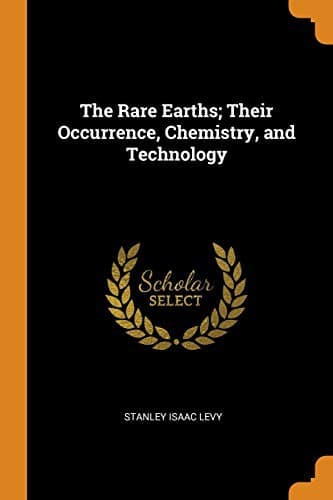
The Rare Earths: Their Occurrence, Chemistry, and TechnologyLevy, Stanley Isaac
Science
The Rare Earths: Their Occurrence, Chemistry, and Technology
Levy, Stanley Isaac
Rare earths
G = 3·473. H = 5¹⁄₂-6. Brown; opaque.
Julianehaab, Greenland.
~Eucolyte.~
R´₄R´´₃Zr(SiO₃)₇, where R´ = K, Na, H, and R´´ = Ce(OH), Fe, Mn, Ca,
and Zr(OCl) may replace SiO₂? A very complex mineral. ZrO₂ = 10·9-20;
Cer = 0-5·2%.
Rhombohedral.
G = 3·0-3·1. H = 5-5¹⁄₂. Red to brown; translucent. Double Refraction
strong, -ve.
Various localities in Norway.
_Eucrasite._
An altered Thorite (_q.v._) containing E, Ca, Fe, Mn, Na, Ti, H₂O,
etc. Cer = 14; Yttr = 5·9; ThO₂ = 36·0; ZrO₂ = 0·6%.
Rhombic (Paijkull). Amorphous, isotropic (Brögger).
G = 4·39. H = 4¹⁄₂-5. Brownish black; opaque.
Near Brevig, Norway.
~Eudialite.~
A variety of Eucolyte (_q.v._) of the same composition.
As Eucolyte.
G = 2·92. Double Refraction strong, +ve. Otherwise as Eucolyte.
Greenland; Lapland; Arkansas, U.S.A.
~Euxenite.~
E(CbO₃)₃,E₂(TiO₃)₃,1¹⁄₂H₂O; with U and Zr. Cer = 2·3-8·4; Yttr =
13·2-34·6; TiO₂ = 20-23%. ThO₂ + ZrO₂ usually in traces.
Orthorhombic; usually massive.
G = 4·6-5·0. H = 6¹⁄₂. Brownish-black; translucent to opaque.
Hitterö, Brevig, Jolster, Arendal, Norway; Cooglegong, Australia; N.
Carolina.
~Fergusonite.~
Approximately E₂O₃, (Cb,Ta)₂O₅, with U, Fe, Ca. Cer = 0·5-13·9; Yttr =
27·9-47·1; ThO₂ + ZrO₂ = 0-7%. [Berzelius found Cer = 36·3; Yttr = 0%
in one specimen.]
Tetragonal, polar.
G = 5·84-4·3 when largely hydrated. H = 5·6. Brown to black.
Norway; Australia; Texas, etc.
_Florencite._
A silico-phosphate of E and Al. Cer = 28% approximately.
G = 3·6. H = 5. Yellow to red. Resinous lustre.
Minas Geraes and diamond localities in Brazil.
_Fluocerite._
Basic fluoride of rare earth metals, E₂O₃,4EF₃. Cer = 81·4-82·6; Yttr
= 1·1-4·3%.
Massive. Original hexagonal mineral of Berzelius and Haidinger,
probably Tysonite (_q.v._).
G = 5·7-5·9. H = 4. Reddish yellow; opaque.
Österby, Sweden.
_Freyalite._
Silicate of E and Th, with Al, Fe, Mn, Na, aq., etc. Cer = 31·3; ThO₂
= 28·4; ZrO₂ = 6·3%.
Amorphous.
G = 4·06-4·17. H = 6. Brown; opaque; lustre resinous.
Brevig, Norway.
~Gadolinite.~
FeO, 2BeO, Y₂O₃, 2SiO₂, where Y = yttrium metals. Cer = 3·4-51·5
(usual 6-20); Yttr = 5-60 (usual 35-48)%.
Monoclinic; habit prismatic. Often amorphous and isotropic.
G = 4·0-4·5. H = 6¹⁄₂-7. Brown and green. Double Refraction strong,
+ve.
Ytterby and Fahlun, Sweden; Hitterö and Malö, Norway; Llano Co.,
Texas; Colorado, etc.
Geikielite.
(Mg,Fe´´)TiO₃. TiO₂ = 56·1-64·8%. Specimens rich in iron are called
Picroilmenite.
Massive.
G = 4 about. H = 6. Purplish or brownish black.
Ceylon.
Gorceixite.
An alumino-phosphate of alkaline and ceria earths. Cer = 0-3%.
Microcrystalline.
G = 3. H = 6. White to brown. Translucent.
Diamond sands of Brazil.
Guarinite.
Formerly supposed to be dimorphous with Titanite (_q.v._); shown by
Zambonini and Prior (1909) to be identical with Hiortdahlite (_q.v._).
Hainite.
Public-domain text, read in full here on John Shaqi.
Reviews
Reviews
No reviews yet
Be the first to share your thoughts on this work.
Join the Discussion
Join the discussion
Sign in to leave a comment or review.
Sign InorCreate an account