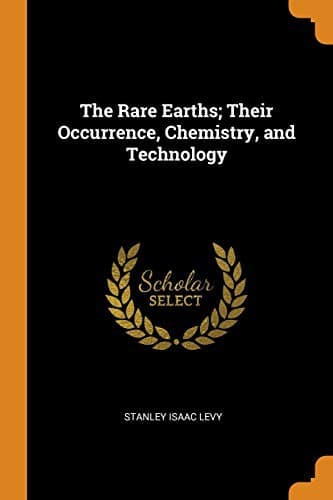
The Rare Earths: Their Occurrence, Chemistry, and Technology — John Shaqi
The Rare Earths: Their Occurrence, Chemistry, and TechnologyLevy, Stanley Isaac
Science
The Rare Earths: Their Occurrence, Chemistry, and Technology
Levy, Stanley Isaac
Rare earths
[40] _Centr. Min._ 1911, 4.
Allanite is of very wide distribution, though it is not often found in
large quantities. The usual occurrence in pegmatitic veins in granites,
syenites and other acid plutonic rocks has been often noted, _e.g._ in
many parts of Sweden and Norway. It is found also in the extinct crater
now forming the Laacher See, near Coblenz, Germany, and at Impilaks,
near Lake Ladoga, on the border of Finland; a mass of the pure mineral
weighing 300 lb. was recently discovered at Barringer Hill, (cf. under
Gadolinite), and it occurs in large quantities in Amherst Co., Virginia.
It is an accessory constituent of many acid volcanic and hypabyssal
rocks, and has been found also in limestone, and in magnetic iron ores.
On account of its exceedingly wide distribution, and the variations in
appearance and composition, it has been repeatedly described under
various names, varieties being constantly mistaken for new mineral
species.
Its history is rather curious.[41] In 1806 the Danish mineralogist
Giesecke made a protracted voyage to Greenland, collecting minerals and
rocks; he remained there until 1813. In 1808 he sent off his first
collection by ship to Copenhagen; on the voyage the ship was taken by an
English privateer, and the cargo landed and sold at Leith. The minerals
were bought by Allan, a Scotch mineralogist, who recognised, that they
were from Greenland by the presence of cryolite, at that time only known
to occur in Greenland. He mistook the mineral subsequently named after
him for gadolinite, and sent it to Thomson for analysis.[42] Thomson
recognised it as a new mineral, and named it Allanite (1810). In 1815
Hisinger described a mineral from Ryddarhyttan, Sweden, which he called
Cerin; Leonhard (1821) and Hauy (1822) showed that this was identical
with Allanite. In 1818 Berzelius described two varieties of a mineral
from Finbo, near Fahlun, Sweden, which he called Orthite, and
Pyrorthite; these were eventually shown by Scheerer (1844) to be
varieties of Allanite. In 1824 the French mineralogist Lévy described a
mineral from Arendal, Norway, which he named Bucklandite, in honour of
the English naturalist; in 1825 this was identified with a ‘black
zeolite’ from the Laacher See by G. Rose, and in 1828 both were shown by
Hermann to have the same composition as orthite or allanite. The list
might be extended at will; the Tautolite of Kokscharow (1847), the
Bodenite of Breithaupt (1844), the Muromontite of Kemdt (1848), and the
Vasite of Bahr (1863) have all been shown to be varieties of the same
bewildering mineral.
[41] _Vide_ Schilling, pp. 75-76, where full references are given.
[42] See Kobell’s _Geschichte der Mineralogie_, 1864, p. 679.
Public-domain text, read in full here on John Shaqi.
Reviews
Reviews
No reviews yet
Be the first to share your thoughts on this work.
Join the Discussion
Join the discussion
Sign in to leave a comment or review.
Sign InorCreate an account