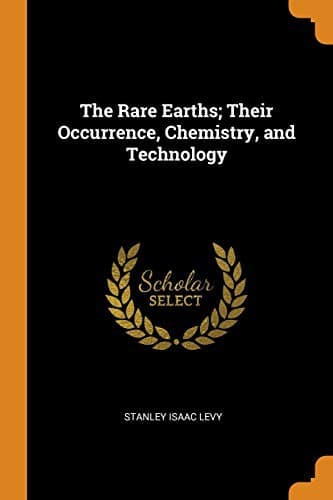
The Rare Earths: Their Occurrence, Chemistry, and TechnologyLevy, Stanley Isaac
Science
The Rare Earths: Their Occurrence, Chemistry, and Technology
Levy, Stanley Isaac
Rare earths
It is very similar to fluorspar (except that the octahedral cleavage of
the latter is very good), and is regarded by Vogt as an isomorphous
mixture of the latter with yttrium fluoride (or with a double yttrium
calcium fluoride, which is less probable). This view would account for
the variations in composition, and also for the remarkable frequency
with which traces of rare earths are found in fluorspar (_vide_ p. 2).
Yttrocerite is regarded as a similar isomorphous mixture, but containing
cerium metals in addition to the yttrium group.
Yttrofluorite occurs in pegmatite veins in granite in Northern Norway,
with gadolinite, fergusonite, allanite, fluorspar, and the usual vein
minerals.
* * * * *
The other members of this family (see list) are:
_Fluocerite_, a basic fluoride of yttrium and cerium metals.
_Tysonite_, a hydrated fluoride containing carbonates.
It is to be noticed that fluorine is the only member of the halogen
family which occurs in nature in combination with rare earth elements.
This fact is possibly connected with the great age of the rare earth
minerals, and their formation during pneumatolytic metamorphism of
plutonic rocks (_vide_ Chapter I).
CHAPTER VII
THE MONAZITE SANDS
It has been stated that monazite is a not uncommon accessory constituent
of many rocks, particularly of granites, gneisses, diorites, etc. The
crystalline material, of which an account has been given, is found
sometimes in veins in these rocks, more often in tiny crystals
disseminated throughout the mass. Most of these monazite-bearing rocks
are extremely old, belonging to the Archæan or pre-Cambrian age, and
probably none are of secondary (Mesozoic) or later age. It follows,
then, that they have been subjected to erosion during practically the
whole immense period of which geology can give us any detailed
knowledge. Heat, frost, wind, the action of vegetation and of
percolating water, the innumerable weathering agents known to the
geologist, have been at work on them during countless ages, breaking,
crushing, dissolving; rains, brooks, rivers, even ocean-waves have
dissolved or washed away the fragments, sorted them out unerringly
according to density, and re-deposited them, now in a river-bed, now at
the base of some sea cliff, now in a wide alluvial plain from which the
water has long since retired. It is in deposits of this nature that the
monazite has been concentrated. Its relatively high specific gravity
(about 5·0) has secured its separation from the lighter mica, quartz,
and felspar of the parent-rock; but the heavier vein or accessory
minerals have, of course, been concentrated with it. Zircon is an
invariable constituent of these ‘monazite sands,’ as such deposits are
called; and others almost as frequently found are rutile, ilmenite,
sphene (titanite), and apatite. Common, too, are the characteristic
minerals of the metamorphic rocks, garnet, epidote, sillimanite,
tourmaline, etc.
Public-domain text, read in full here on John Shaqi.
Reviews
Reviews
No reviews yet
Be the first to share your thoughts on this work.
Elsewhere in the archive
Join the Discussion
Join the discussion
Sign in to leave a comment or review.
Sign InorCreate an account