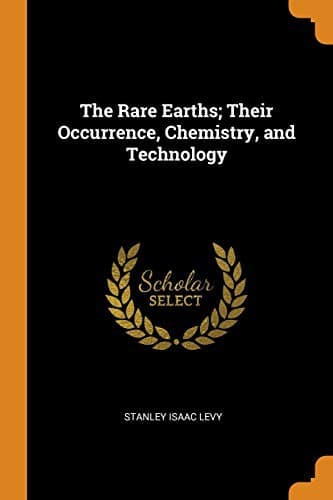
The Rare Earths: Their Occurrence, Chemistry, and TechnologyLevy, Stanley Isaac
Science
The Rare Earths: Their Occurrence, Chemistry, and Technology
Levy, Stanley Isaac
Rare earths
Whilst deposits of commercial importance are not very common, improved
scientific methods and more careful search have shown that in traces the
rare earths are of exceedingly wide distribution. Sir William Crookes
has shown that yttria earths are often present in calcite and in coral;
whilst Headden[4] noted that quite considerable amounts (up to 0·03 per
cent.) were present in a yellow phosphorescent variety of calcite from
Colorado. Similarly Humphreys[5] found that fluorspar usually contains
traces of yttrium, whilst one or two phosphorescent varieties contain
quantities varying up to 0·05 per cent. The presence of yttria elements
in phosphorescent varieties of calcite is interesting, and some
connection has been suggested; there is, however, no positive ground for
the belief in such a relation.
[4] _Amer. J. Sci._, 1906, [iv.], ~21~, 301.
[5] _Astrophys. J._, 1904, ~20~, 266.
More recently Eberhard[6] has found very considerable quantities of rare
earths in cassiterite (tin dioxide, SnO₂) and wolframite [an iron
manganese tungstate, (Fe,Mn)WO₄]. A specimen of wolframite from the
Erzgebirge was found to contain nearly 0·4 per cent. of rare earths,
over half of this quantity being scandium oxide. A process which is
readily susceptible of commercial application has been worked out by R.
J. Meyer,[7] for the extraction of scandia and the yttria earths from
the mixed oxides left after the treatment of wolframite for tungstic
acid.
[6] _Sitzungsber. königl. Akad. Wiss. Berlin_, 1908, 851; 1910, 404.
[7] Meyer, _Zeitsch. anorg. Chem._, 1908, ~60~, 134. Meyer und Winter,
_ibid._, 1910, ~67~, 398.
Using the spectroscopic method, which is capable of detecting one part
of scandia in twenty thousand, Eberhard (_loc. cit._) has found that
minute quantities of scandia and yttria earths are present in almost all
the commoner rocks and minerals. The minerals richest in scandium were
beryl, cassiterite, wolfram, the zircon minerals, and the titanates and
columbates of the ceria and yttria oxides. These results are in
agreement with the observations of Sir William Crookes,[8] who has made
the study of scandium especially his own. From the fact that scandium
was often observed unaccompanied by any other member of the rare earth
group, Eberhard rather favours Urbain’s conclusion[9] that scandium may
not be a member of the rare earth family. Spectroscopic examination has
also shown the existence of some of the rare earth elements in the sun
and stars (see Europium, p. 189).
[8] _Phil. Trans._ 1910, A, ~210~, 359.
[9] See under Scandium in Pt. II.
Public-domain text, read in full here on John Shaqi.
Reviews
Reviews
No reviews yet
Be the first to share your thoughts on this work.
Join the Discussion
Join the discussion
Sign in to leave a comment or review.
Sign InorCreate an account