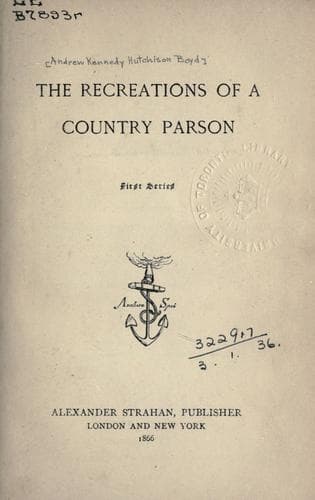
The Recreations of a Country ParsonBoyd, Andrew Kennedy Hutchison
General
The Recreations of a Country Parson
Boyd, Andrew Kennedy Hutchison
Clergy -- Anecdotes; Country life -- England; Rural clergy -- England
The railway carriages that run between Glasgow and Greenock have a
rather peculiar appearance. The first-class carriages are of twice
the usual length, having six compartments instead of three. Each
compartment holds eight passengers; and as this accommodation is
gained by increasing the breadth of the carriages, brass bars are
placed across the windows, to prevent any one from putting out his
head. Should any one do so, his head would run some risk of coming
in collision with the other train; and although, from physiological
reasons, tome heads might receive no injury in such a case, the
carriage with which they came in contact would probably suffer.
The expense of painting is saved by the carriages being built of
teak, which when varnished has a cheerful light-oak colour. There
is a great crowd of men on the platform, for the four o'clock train
is the chief down-train of the day. The bustle of the business-day
is over; there is a general air of relief and enjoyment. We meet our
friend punctual to the minute; we take our seat on the comfortable
blue cushions; the bell rings; the engine pants and tugs; and we
are off 'down the water.'
We pass through a level country on leaving Glasgow: there are the
rich fields which tell of Scotch agricultural industry. It is a
bright August afternoon: the fields are growing yellow; the trees
and hedges still wear their summer green. In a quarter of an hour
the sky suddenly becomes overcast. It is not a cloud: don't be afraid
of an unfavourable change of weather; we have merely plunged into
the usual atmosphere of dirty and ugly Paisley. Without a pause,
we sweep by, and here turn off to the right. That line of railway
from which we have turned aside runs on to Dumfries and Carlisle;
a branch of it keeps along the Ayrshire coast to Ardrossan and Ayr.
In a little while we are skimming the surface of a bleak, black
moor; it is a dead level, and not in the least interesting: but,
after a plunge into the mirk darkness of a long tunnel, we emerge
into daylight again; and there, sure enough, are the bright waters
of the Clyde. We are on its south side; it has spread out to the
breadth of perhaps a couple of miles. That rocky height on its north
shore is Dumbarton Castle; that great mass beyond is Ben Lomond,
at whose base lies Loch Lomond, the queen of Scottish lakes, now
almost as familiar to many a cockney tourist as a hundred years since
to Rob Roy Macgregor. We keep close by the water's edge, skirting
a range of hills on which grow the finest strawberries in Scotland.
Soon, to the right, we see many masts, many great rafts of timber,
many funnels of steamers; and there, creeping along out in the middle
of the river, is the steamer we are to join, which left Glasgow
an hour before us. We have not stopped since we left Glasgow;
thirty-five minutes have elapsed, and now we sweep into a remarkably
tasteless and inconvenient station. This is Greenock at last; but,
Public-domain text, read in full here on John Shaqi.
Reviews
Reviews
No reviews yet
Be the first to share your thoughts on this work.
Elsewhere in the archive
Join the Discussion
Join the discussion
Sign in to leave a comment or review.
Sign InorCreate an account