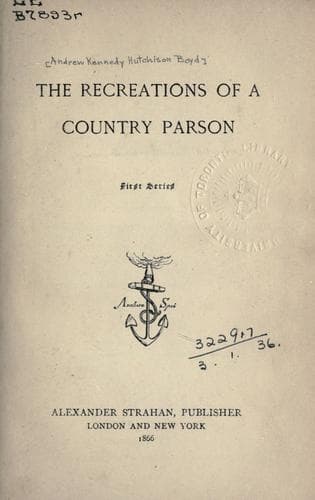
The Recreations of a Country ParsonBoyd, Andrew Kennedy Hutchison
General
The Recreations of a Country Parson
Boyd, Andrew Kennedy Hutchison
Clergy -- Anecdotes; Country life -- England; Rural clergy -- England
Because she is right, Nature is ours: more truly ours than we
ourselves. We turn from the inward ruin to the outward glory, and
marvel at the contrast. But we need not marvel: it is the difference
of life and death: piercing the dimness even of man's darkened
sense, jarring upon his fond illusion like waking realities upon
a dream. Without is living holiness, within is deathly wrong.
Let the reader, ever remembering that in such cases analogy is not
argument but illustration--that it makes a doctrine clearer, but
does not in any degree confirm it--read the chapter entitled 'Of
the illustration from Astronomy.' It will tend to make the great
doctrine of Man and his Dwelling-Place comprehensible; you will
see exactly what it is, although you may not think it true. As
astronomy has transferred the apparent movements of the planets
from them to ourselves, so, says our author, has science transferred
the seeming inertness of Nature from it to us. The phenomenon of
Nature is physical and inert: the being is spiritual and active
and holy. And if we now seem to have an insuperable conviction that
Man is not inert and that Nature is inert, it is not stronger than
our apparent consciousness that the earth is unmoving. Man lives
under illusion as to himself and as to the universe. Reason, indeed,
furnishes him with the means of correcting that illusion; but in
that illusion is his want of life.
Strong in his conviction of the grand principle which he has
established, as he conceives, in his first book, the author, in
his second book, goes crashing through all systems of philosophy.
His great doctrine makes havock of them all. All are wrong; though
each may have some grain of truth in it. The Idealists are right
in so far as that there is no such thing as Matter. Matter is the
vain imagination of man through his wrong idea of Nature's inertness.
But the Idealists are wrong if they fancy that because there is
no Matter, there is nothing but Mind, and ideas in Mind. Nature,
though spiritual, has a most real and separate existence. Then the
sceptics are right in so far as they doubt what our author thinks
wrong; but they are wrong in so far as they doubt what our author
thinks right. Positivism is right in so far as it teaches that we
see all things relatively to ourselves, and so wrongly; but it is
wrong in teaching that what things are in themselves is no concern
of ours, and that we should live on as though things were what they
seem.
Public-domain text, read in full here on John Shaqi.
Reviews
Reviews
No reviews yet
Be the first to share your thoughts on this work.
Elsewhere in the archive
Join the Discussion
Join the discussion
Sign in to leave a comment or review.
Sign InorCreate an account