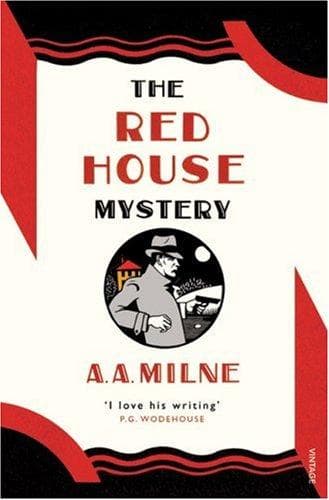
The Red House MysteryMilne, A. A. (Alan Alexander)
General
The Red House Mystery
Milne, A. A. (Alan Alexander)
Detective and mystery stories; England -- Fiction
Cayley had been in the hall when Robert was shown into the office. The
servant goes off to look for Mark, and Cayley goes on with his book.
Mark comes down the stairs, warns Cayley to stand by in case he is
wanted, and goes to meet his brother. What does Cayley expect? Possibly
that he won’t be wanted at all; possibly that his advice may be wanted
in the matter, say, of paying Robert’s debts, or getting him a passage
back to Australia; possibly that his physical assistance may be wanted
to get an obstreperous Robert out of the house. Well, he sits there for
a moment, and then goes into the library. Why not? He is still within
reach, if wanted. Suddenly he hears a pistol-shot. A pistol-shot is the
last noise you expect to hear in a country-house; very natural, then,
that for the moment he would hardly realize what it was. He listens—and
hears nothing more. Perhaps it wasn’t a pistol-shot after all. After a
moment or two he goes to the library door again. The profound silence
makes him uneasy now. _Was_ it a pistol-shot? Absurd! Still—no harm in
going into the office on some excuse, just to reassure himself. So he
tries the door—and finds it locked!
What are his emotions now? Alarm, uncertainty. Something is happening.
Incredible though it seems, it must have been a pistol-shot. He is
banging at the door and calling out to Mark, and there is no answer.
Alarm—yes. But alarm for whose safety? Mark’s, obviously. Robert is a
stranger; Mark is an intimate friend. Robert has written a letter that
morning, the letter of a man in a dangerous temper. Robert is the tough
customer; Mark the highly civilized gentleman. If there has been a
quarrel, it is Robert who has shot Mark. He bangs at the door again.
Of course, to Antony, coming suddenly upon this scene, Cayley’s conduct
had seemed rather absurd, but then, just for the moment, Cayley had
lost his head. Anybody else might have done the same. But, as soon as
Antony suggested trying the windows, Cayley saw that that was the
obvious thing to do. So he leads the way to the windows—the longest
way.
Why? To give the murderer time to escape? If he had thought then that
Mark was the murderer, perhaps, yes. But he thinks that Robert is the
murderer. If he is not hiding anything, he _must_ think so. Indeed he
says so, when he sees the body; “I was afraid it was Mark,” he says,
when he finds that it is Robert who is killed. No reason, then, for
wishing to gain time. On the contrary, every instinct would urge him to
get into the room as quickly as possible, and seize the wicked Robert.
Yet he goes the longest way round. Why? And then, why _run?_
Public-domain text, read in full here on John Shaqi.
Reviews
Reviews
No reviews yet
Be the first to share your thoughts on this work.
Join the Discussion
Join the discussion
Sign in to leave a comment or review.
Sign InorCreate an account