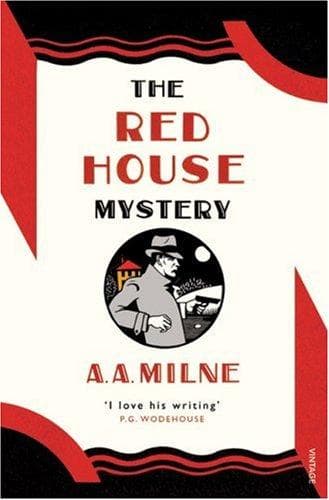
The Red House MysteryMilne, A. A. (Alan Alexander)
General
The Red House Mystery
Milne, A. A. (Alan Alexander)
Detective and mystery stories; England -- Fiction
“That’s the question,” said Antony to himself, as he filled his pipe,
“and bless me if I know the answer. It may be, of course, that Cayley
is just a coward. He was in no hurry to get close to Robert’s revolver,
and yet wanted me to think that he was bursting with eagerness. That
would explain it, but then that makes Cayley out a coward. Is he? At
any rate he pushed his face up against the window bravely enough. No, I
want a better answer than that.”
He sat there with his unlit pipe in his hand, thinking. There were one
or two other things in the back of his brain, waiting to be taken out
and looked at. For the moment he left them undisturbed. They would come
back to him later when he wanted them.
He laughed suddenly, and lit his pipe.
“I was wanting a new profession,” he thought, “and now I’ve found it.
Antony Gillingham, our own private sleuthhound. I shall begin to-day.”
Whatever Antony Gillingham’s other qualifications for his new
profession, he had at any rate a brain which worked clearly and
quickly. And this clear brain of his had already told him that he was
the only person in the house at that moment who was unhandicapped in
the search for truth. The inspector had arrived in it to find a man
dead and a man missing. It was extremely probable, no doubt, that the
missing man had shot the dead man. But it was more than extremely
probable, it was almost certain that the Inspector would start with the
idea that this extremely probable solution was the one true solution,
and that, in consequence, he would be less disposed to consider without
prejudice any other solution. As regards all the rest of them—Cayley,
the guests, the servants—they also were prejudiced; in favour of Mark
(or possibly, for all he knew, against Mark); in favour of, or against,
each other; they had formed some previous opinion, from what had been
said that morning, of the sort of man Robert was. No one of them could
consider the matter with an unbiased mind.
But Antony could. He knew nothing about Mark; he knew nothing about
Robert. He had seen the dead man before he was told who the dead man
was. He knew that a tragedy had happened before he knew that anybody
was missing. Those first impressions, which are so vitally important,
had been received solely on the merits of the case; they were founded
on the evidence of his senses, not on the evidence of his emotions or
of other people’s senses. He was in a much better position for getting
at the truth than was the Inspector.
Public-domain text, read in full here on John Shaqi.
Reviews
Reviews
No reviews yet
Be the first to share your thoughts on this work.
Join the Discussion
Join the discussion
Sign in to leave a comment or review.
Sign InorCreate an account