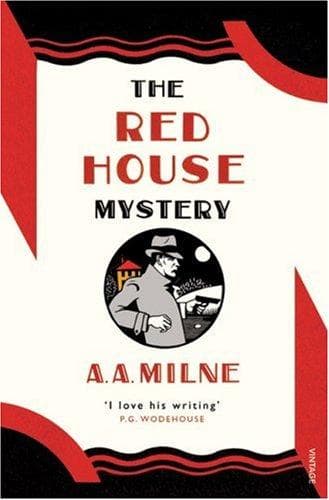
The Red House MysteryMilne, A. A. (Alan Alexander)
General
The Red House Mystery
Milne, A. A. (Alan Alexander)
Detective and mystery stories; England -- Fiction
“If you remember, Audrey, I always said there was no saying with anyone
from Australia.” Mrs. Stevens lay back in her chair, breathing rather
rapidly. “I wouldn’t go out of this room now, not if you paid me a
hundred thousand pounds.”
“Oh, Mrs. Stevens!” said Elsie, who badly wanted five shillings for a
new pair of shoes, “I wouldn’t go as far as that, not myself, but—”
“There!” cried Mrs. Stevens, sitting up with a start. They listened
anxiously, the two girls instinctively coming closer to the older
woman’s chair.
A door was being shaken, kicked, rattled.
“Listen!”
Audrey and Elsie looked at each other with frightened eyes.
They heard a man’s voice, loud, angry.
“Open the door!” it was shouting. “Open the door! I say, open the
door!”
“Don’t open the door!” cried Mrs. Stevens in a panic, as if it was her
door which was threatened. “Audrey! Elsie! Don’t let him in!”
“Damn it, open the door!” came the voice again.
“We’re all going to be murdered in our beds,” she quavered. Terrified,
the two girls huddled closer, and with an arm round each, Mrs. Stevens
sat there, waiting.
CHAPTER II.
Mr. Gillingham Gets Out at the Wrong Station
Whether Mark Ablett was a bore or not depended on the point of view,
but it may be said at once that he never bored his company on the
subject of his early life. However, stories get about. There is always
somebody who knows. It was understood—and this, anyhow, on Mark’s own
authority—that his father had been a country clergyman. It was said
that, as a boy, Mark had attracted the notice, and patronage, of some
rich old spinster of the neighbourhood, who had paid for his education,
both at school and university. At about the time when he was coming
down from Cambridge, his father had died; leaving behind him a few
debts, as a warning to his family, and a reputation for short sermons,
as an example to his successor. Neither warning nor example seems to
have been effective. Mark went to London, with an allowance from his
patron, and (it is generally agreed) made acquaintance with the
money-lenders. He was supposed, by his patron and any others who
inquired, to be “writing”; but what he wrote, other than letters asking
for more time to pay, has never been discovered. However, he attended
the theatres and music halls very regularly—no doubt with a view to
some serious articles in the “Spectator” on the decadence of the
English stage.
Public-domain text, read in full here on John Shaqi.
Reviews
Reviews
No reviews yet
Be the first to share your thoughts on this work.
Join the Discussion
Join the discussion
Sign in to leave a comment or review.
Sign InorCreate an account