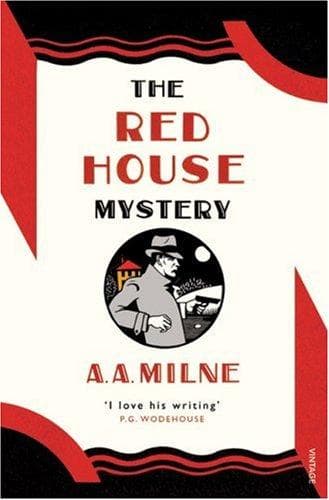
The Red House MysteryMilne, A. A. (Alan Alexander)
General
The Red House Mystery
Milne, A. A. (Alan Alexander)
Detective and mystery stories; England -- Fiction
Fortunately (from Mark’s point of view) his patron died during his
third year in London, and left him all the money he wanted. From that
moment his life loses its legendary character, and becomes more a
matter of history. He settled accounts with the money-lenders,
abandoned his crop of wild oats to the harvesting of others, and became
in his turn a patron. He patronized the Arts. It was not only usurers
who discovered that Mark Ablett no longer wrote for money; editors were
now offered free contributions as well as free lunches; publishers were
given agreements for an occasional slender volume, in which the author
paid all expenses and waived all royalties; promising young painters
and poets dined with him; and he even took a theatrical company on
tour, playing host and “lead” with equal lavishness.
He was not what most people call a snob. A snob has been defined
carelessly as a man who loves a lord; and, more carefully, as a mean
lover of mean things—which would be a little unkind to the peerage if
the first definition were true. Mark had his vanities undoubtedly, but
he would sooner have met an actor-manager than an earl; he would have
spoken of his friendship with Dante—had that been possible—more glibly
than of his friendship with the Duke. Call him a snob if you like, but
not the worst kind of snob; a hanger-on, but to the skirts of Art, not
Society; a climber, but in the neighbourhood of Parnassus, not Hay
Hill.
His patronage did not stop at the Arts. It also included Matthew
Cayley, a small cousin of thirteen, whose circumstances were as limited
as had been Mark’s own before his patron had rescued him. He sent the
Cayley cousin to school and Cambridge. His motives, no doubt, were
unworldly enough at first; a mere repaying to his account in the
Recording Angel’s book of the generosity which had been lavished on
himself; a laying-up of treasure in heaven. But it is probable that, as
the boy grew up, Mark’s designs for his future were based on his own
interests as much as those of his cousin, and that a suitably educated
Matthew Cayley of twenty-three was felt by him to be a useful property
for a man in his position; a man, that is to say, whose vanities left
him so little time for his affairs.
Cayley, then, at twenty-three, looked after his cousin’s affairs. By
this time Mark had bought the Red House and the considerable amount of
land which went with it. Cayley superintended the necessary staff. His
duties, indeed, were many. He was not quite secretary, not quite
land-agent, not quite business-adviser, not quite companion, but
something of all four. Mark leant upon him and called him “Cay,”
objecting quite rightly in the circumstances to the name of Matthew.
Cay, he felt was, above all, dependable; a big, heavy-jawed, solid
fellow, who didn’t bother you with unnecessary talk—a boon to a man who
liked to do most of the talking himself.
Public-domain text, read in full here on John Shaqi.
Reviews
Reviews
No reviews yet
Be the first to share your thoughts on this work.
Join the Discussion
Join the discussion
Sign in to leave a comment or review.
Sign InorCreate an account