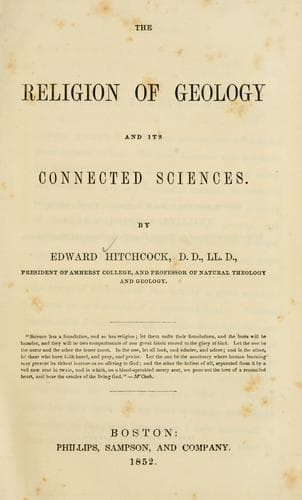
The Religion of Geology and Its Connected SciencesHitchcock, Edward
Religion
The Religion of Geology and Its Connected Sciences
Hitchcock, Edward
Bible and geology; Religion and science
To show that such is the case, by an appeal to facts, would be, in truth,
to write the history of every natural process, and show its design. But it
will be sufficient to consider only such cases as appear most decidedly to
militate against my position, and to show that even these are not
designed to cause evil or suffering.
How does it happen, then, you may inquire, that evil is the result of a
multitude of contrivances and processes in nature? It is an incidental
effect, I answer; that is, an effect happening aside from the main design
of the contrivance. Take a few illustrations.
No one can doubt that the law of gravity is essential to the preservation
and comfort of the world, and to the harmonious motions of the heavenly
bodies. Yet how often does it give rise to frightful accidents to men and
animals! But when they are crushed by falling bodies, or by falling
themselves, who imagines this to be the design of gravitation? How clear
that its real object is beneficial, and that the evil resulting from it is
unavoidable in a world constituted like ours! Why the world is not
constituted differently, is an inquiry which men may try to answer; but an
answer is not important to my present object.
Take an example from the organic world. Every one is aware that without a
nervous system in animals there would be no sensibility, nor sensation,
and, of course, no enjoyment; and without these, animals would be
unconscious of danger, and would not guard against it, nor withdraw from
it. We are sure, therefore, that these two objects are the grand design of
the nervous system, and, of course, it is a benevolent design. But the
nervous system causes a great deal of suffering as well as pleasure.
Obviously, however, this is only an incidental effect, which could not be
prevented without a miracle; while the main design is to produce happiness
and guard against evil.
It may be asked, however, by what principle we can determine what is the
design of a contrivance, and what the incidental effect. Why select a
part of the effects, and call them the object aimed at by the contriver,
while we regard others as incidental, and merely permitted, not intended?
Public-domain text, read in full here on John Shaqi.
Reviews
Reviews
No reviews yet
Be the first to share your thoughts on this work.
Elsewhere in the archive
Join the Discussion
Join the discussion
Sign in to leave a comment or review.
Sign InorCreate an account