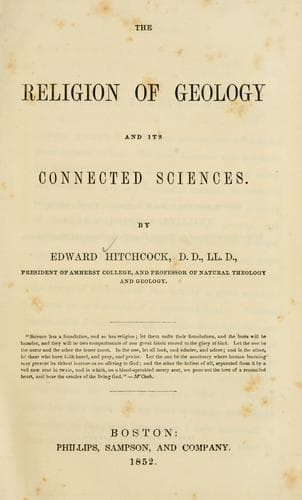
The Religion of Geology and Its Connected SciencesHitchcock, Edward
Religion
The Religion of Geology and Its Connected Sciences
Hitchcock, Edward
Bible and geology; Religion and science
The principle on which we make this distinction is very clear. We judge of
the design of a contrivance by its predominant tendencies and effects. If
evil as often results as good, misery as often as happiness, we could not
decide whether the design was benevolent or malevolent, or an indifference
to both. But the benevolent tendency and effects of every natural
contrivance are so obvious, and so immensely outweigh all its evil
results, that we are compelled to admit the design of the Author of nature
to be benevolent. And, therefore, when we see evil occasionally result
from such contrivances, we are authorized to say that this is only an
incidental effect; not, indeed, wholly undesigned, for we cannot doubt
that God has a design in the permission of all evil. But for each
particular arrangement and movement in nature we can discover a
predominant and benevolent object.
Take another example from the human frame. In that frame we find a
multitude of organs, nearly all of which are obviously adapted to a
particular use. Now, the anatomist cannot lay his finger upon one of them,
and say, This was intended to produce derangement and suffering in the
system. Here is a muscle contrived to clog the operations of its
neighbors; here a blood-vessel adapted to corrupt the blood and produce
disease; here a gland whose object is to secrete a poisonous fluid, to
contaminate the whole system; here a nerve made to produce pain; here a
plexus of vessels suited to bring on disease. On the contrary, this
anatomist perceives at once that all the organs of the animal system, and
their collocation, are fitted in the best possible manner to produce
health. It is obvious at a glance that this is their design.
But if such be the fact, how happens it that so few persons pass through
life without disease? Is it all to be imputed to an abuse and perversion
of the organs and powers of life? Not so, in my opinion. But those organs
are all liable to disease; and when we see how delicate and complicated
they are, we ought not to wonder that even the unavoidable causes of
derangement should often bring it on. Yet, after all, health is the rule
and the object, and disease only the exception. But I shall say more on
this subject in another part of the argument.
Some one, however, who hears me, has doubtless ere this had his thoughts
recur to the organs of carnivorous animals, the poisonous fangs of
serpents, and the organs of the scorpion, the tarantula, and of insects,
for the generation and protrusion of deadly poison. Here we have organs
expressly provided for the destruction of other animals. That such is
their design, no physiologist can doubt; and hence they are intended to
produce suffering, and not happiness.
Public-domain text, read in full here on John Shaqi.
Reviews
Reviews
No reviews yet
Be the first to share your thoughts on this work.
Elsewhere in the archive
Join the Discussion
Join the discussion
Sign in to leave a comment or review.
Sign InorCreate an account