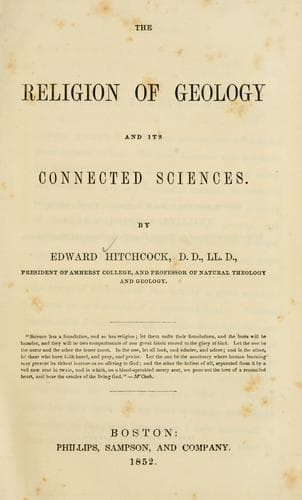
The Religion of Geology and Its Connected SciencesHitchcock, Edward
Religion
The Religion of Geology and Its Connected Sciences
Hitchcock, Edward
Bible and geology; Religion and science
Is this an exactly correct statement of the case? True, suffering is the
result of such organs; but the arrangement is intended to accomplish still
higher purposes. The leading one is to procure food for sustenance, the
other is self-defence. Both of these are essential to the animal's
continued existence. That suffering should be incidentally connected with
instruments or organs so important, is no more difficult to explain than
is the existence of evil any where. The object even of these contrivances,
then, is beneficial. And if so, I know of no other example in nature so
seemingly adverse to the position I have laid down, that the main object
of every natural contrivance is benevolent in its origin and results. If
this be so, how clearly does it indicate the character of the contriver to
be benevolent!
My second argument is derived from the fact that the organic functions
often produce pleasure where suffering was just as consistent with their
most perfect action; or I might say that such are the arrangements of the
natural world, that pleasure often results to sentient beings from its
operations, when they might have been as perfectly performed with the
production of pain. A few illustrations will render the meaning of this
position obvious.
As we look abroad upon nature, one of the most striking traits we discover
is its unbounded variety. With the Psalmist we involuntarily exclaim, _O
Lord, how manifold are thy works!_ It is not merely variety as to form,
texture, attitude, and arrangement; but who can describe the countless
tints of coloring which are spread over the heavens and the earth? Now,
there is in the human soul an aptitude to be pleased with variety; nay,
there is a craving for it. Nor can there be a more terrible infliction
than unvarying monotony and sameness of appearance, arrangement, and
action. If, therefore, the Creator had been malevolent, or indifferent to
the happiness of man and other sentient beings, he might have gratified
this disposition most perfectly by giving to the human soul its present
love of variety, and then spreading over the face of nature a dead
uniformity of figure, position, arrangement, and coloring; forming every
thing upon the same model. And this might have been done without impairing
at all the perfect operation of all her laws that are essential. Every
thing might have been as systematic and harmonious as it now is; but
sentient beings would have been miserable; and this must have been
supremely gratifying to infinite malevolence. He might also have so
constructed the organs of hearing, sight, and smell, that every sound
might have been ungrateful and grating, every odor repulsive, and every
prospect disgusting. While hunger would have urged animals, as it now
does, to seek food, its reception might have been painful, or utterly void
of gustatory enjoyment. So in regard to social enjoyments; we might have
been irresistibly drawn towards our fellow-men, and yet their society
Public-domain text, read in full here on John Shaqi.
Reviews
Reviews
No reviews yet
Be the first to share your thoughts on this work.
Elsewhere in the archive
Join the Discussion
Join the discussion
Sign in to leave a comment or review.
Sign InorCreate an account