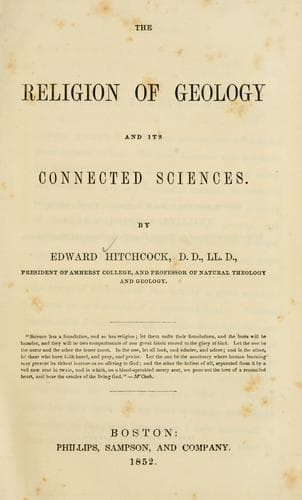
The Religion of Geology and Its Connected SciencesHitchcock, Edward
Religion
The Religion of Geology and Its Connected Sciences
Hitchcock, Edward
Bible and geology; Religion and science
This course of reasoning may be extended, as I judge, to the greatest of
all mortal evils,--I mean death. In the case of the inferior animals, the
amount of physical or mental suffering from this cause is comparatively
small. And if they survive the change of death, surely there is
benevolence in so easy a translation. Or, if they do not exist hereafter,
the stroke of death is a small deduction from the happiness of a whole
life. In man's case, we must not take into the account the aggravations of
death which his own misconduct produces. And aside from these, what a
blessing it would be to be transferred to a more exalted state of being,
by an experience no more painful than that of a Christian dying what may
be called a natural death, by mere decay! Then, too, how much greater
happiness is the result of a succession of beings on earth, than one
undying race would enjoy, both because the successive races would be ever
passing through novel scenes, which would soon become monotonous to a
continuous race, and because, as we have already suggested, a succession
of races admits of the existence, at any one time, of a far greater number
of species! Then, too, we must not forget the salutary moral influence
which man experiences from the expectation of death; so great, indeed,
that without it, it seems doubtful whether the world would be any thing
better than a Pandemonium. In making indissoluble the connection between
sin and death, therefore, in such a system as the present, benevolence
presided with wisdom and justice in the councils of Jehovah.
But in the third lecture I have treated this whole subject so much more
fully, that I need not add any thing further in this connection.
I base my fifth and last argument, to prove the predominance of
benevolence in the present system of nature, on the fact that good so
often results from evil as a natural consequence. Or, to state the
argument in another form, good seems generally to be the object or final
cause of evil, whereas evil flows only incidentally from good.
This argument scarcely differs from the last, except in the more general
form of its statement. That brings forward certain prominent and appalling
evils, and endeavors to show that, in striking the balance of their
effects, the preponderance is on the side of benevolence. This advances a
step farther, and attempts to show that the direct object of evil is to
produce good.
It follows, hence, that the examples adduced and elucidated under the last
argument are not inappropriate to sustain and illustrate the present. Yet
others should be added.
Public-domain text, read in full here on John Shaqi.
Reviews
Reviews
No reviews yet
Be the first to share your thoughts on this work.
Elsewhere in the archive
Join the Discussion
Join the discussion
Sign in to leave a comment or review.
Sign InorCreate an account