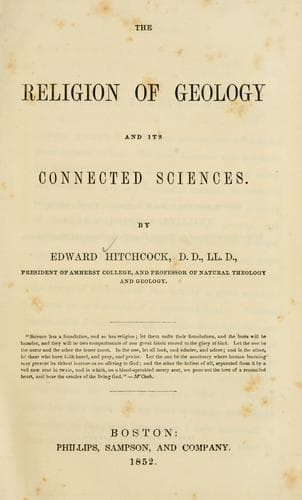
The Religion of Geology and Its Connected SciencesHitchcock, Edward
Religion
The Religion of Geology and Its Connected Sciences
Hitchcock, Edward
Bible and geology; Religion and science
Almost the entire history of medicine and surgery illustrates the manner
in which physical evils result in physical good. Indeed, men never resort
to the physician, or the surgeon, because their remedies and operations
are desirable, but only because they are the necessary means of health and
comfort. These means are, indeed, for the most part, of human invention,
but not, therefore, the less indicative of the divine intention; for they
are founded upon such a constitution in nature as makes it possible to
discover remedies for disease and accidents. And the characteristics of
nature's constitution are an index of the intentions of its Author.
The severe mental discipline through which the youth must pass, who would
attain distinction in learning, affords us an example of intellectual evil
resulting in intellectual wealth and happiness. The trial is too severe
for many irresolute minds, and they give over the effort, and sink down
into a state of indolence and neglect. But he who bears manfully the
discipline will at length gather the golden fruit. And he will be
satisfied, too, of the wisdom and benevolence of that law of mental
progress, which makes it impossible ever to find a royal road to the
temple of learning, and which shuts out from that temple all who shrink
from the preparatory discipline.
Still more strikingly illustrative of this argument are the evils which
men suffer as necessary precursors of moral good. These may be physical or
mental; embracing all those experiences that take the name of trials,
afflictions, and disappointments. These are often intensely bitter, and
they constitute, indeed, the master evils of life. We shudder when we see
them coming; and we often writhe in agony when in the furnace. But how
many have come out of that furnace purified from base alloy, and ready for
the service of God and the world! To do good is henceforth their delight;
and they thank God for the severe discipline. When his heavy blows fell
upon them, one after another, they felt as if they were the strokes of an
incensed Deity. But now they see that they were only the necessary
inflictions of infinite love. And they admire the wisdom that could thus
educe so much good out of so great evil.
I do not contend that good is always educed from evil in this world, or
could be; but only that, in a plurality of cases, if men improve the evils
they suffer as they might, such would be the effect. And if this be
admitted, it is sufficient to establish the general principle, that one of
the direct objects of evil in this world is to produce individual benefit.
But the converse of this proposition cannot be maintained. We cannot,
indeed, deny that evil sometimes results from good; but never as the
direct object of the latter. The effect is only incidental; that is, not
as the main object; and so a few cases of this sort cannot invalidate the
proposition which I defend.
Public-domain text, read in full here on John Shaqi.
Reviews
Reviews
No reviews yet
Be the first to share your thoughts on this work.
Elsewhere in the archive
Join the Discussion
Join the discussion
Sign in to leave a comment or review.
Sign InorCreate an account