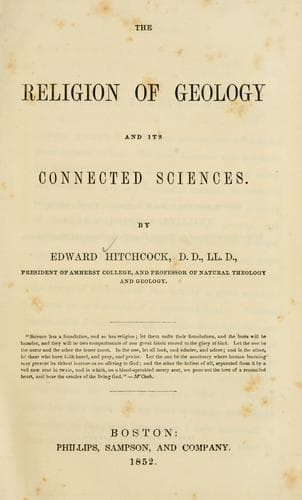
The Religion of Geology and Its Connected SciencesHitchcock, Edward
Religion
The Religion of Geology and Its Connected Sciences
Hitchcock, Edward
Bible and geology; Religion and science
I might multiply much more the arguments furnished by nature to prove a
predominance of benevolence in the arrangements and operations of the
present system of things. But I see no way of escaping the force of those
presented, and cannot doubt that all will admit the conclusion. I advance,
therefore to a second proposition, and maintain that _the benevolence
exhibited in the present system of nature is not unmixed_.
I mean, by this statement, that the divine benevolence exhibited in this
world is modified by other perfections. While there is a predominance of
benevolence, there are also indications of God's displeasure; or, at
least, his dealings seem to be adapted to restrain and amend a wicked
race, rather than to make an innocent and holy race happy; so that the
condition of the human family is far less happy than unmixed benevolence
would confer.
In proof of this assertion, I maintain, first, that evil is incidental to
every process and event in nature.
This is preeminently true of all those actions which we call vicious.
Indeed, they are in themselves evils of the worst kind; and not only so,
but they are connected incidentally with scarcely any thing but evil,
though sometimes, as theologians say, overruled for good.
Take next the common operations of nature, which, of course, have no moral
character. Their leading design, as we have already seen, is to produce
good to sentient beings; but incidentally they bring much evil. Food is
intended for gustatory enjoyment and for nourishment; but it is often the
occasion of severe suffering, and becomes an active poison. Gravity is
intended to hold the material universe in a proper balance, and to attach
every moving thing on earth to the surface; but it occasions a vast number
of accidents, and a vast amount of suffering. Water and fire are of
immense direct benefit; yet the first buries a vast amount of property and
life in its bosom, and the latter is scarcely less injurious in its
incidental effects. Indeed, what natural agency can be named, that is not
armed with the power to do evil?
Public-domain text, read in full here on John Shaqi.
Reviews
Reviews
No reviews yet
Be the first to share your thoughts on this work.
Elsewhere in the archive
Join the Discussion
Join the discussion
Sign in to leave a comment or review.
Sign InorCreate an account