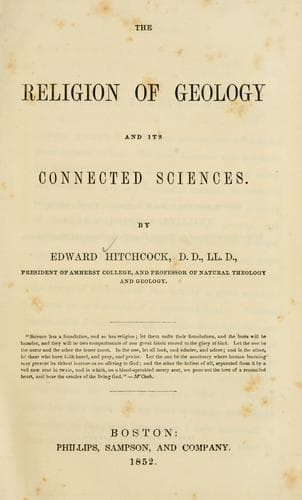
The Religion of Geology and Its Connected SciencesHitchcock, Edward
Religion
The Religion of Geology and Its Connected Sciences
Hitchcock, Edward
Bible and geology; Religion and science
But the same principle extends also to benevolent actions. With our views
of divine benevolence, we might expect that virtuous conduct would never
be coupled with evil. But this notion does not accord with facts; for the
incidental evils connected with benevolent action are often the most
painful in life. Indeed, in how many instances has doing good been
rewarded by the loss of life, and under all the aggravations of suffering
which malignant ingenuity could invent! And the fact has been, that those
whose motives in doing good were the purest have suffered the most.
Witness the life and the death of Him who knew no sin, and yet was led as
a lamb to the slaughter. Since wickedness in this world is sometimes
allowed to have the power of annoying goodness we might expect that the
more disinterested the latter, the more malignant and persecuting would be
the former, because its own deformity is made more manifest.
But the incidental evils connected with benevolent action are not limited
to those resulting from the malice of the wicked. If, for instance, some
huge system of iniquity has become incorporated into the very texture of
society, benevolence cannot root it out without producing many a severe
laceration of individuals, who are incidentally connected with the system,
but to whom no blame attaches. The history of the efforts that have been
made to substitute Christianity for heathenism and other false religions,
is full of examples illustrative of this principle, in conformity with the
remarkable declaration of Christ, _Think not that I am come to send peace
on earth; I came not to send peace, but a sword._ Alike prolific of
illustrations are all the great attempted reforms which the world has
witnessed, whether for delivering religion from human corruptions, or
eradicating slavery, or intemperance, or breaking the political yoke of
the oppressor. In fine, no reasonable man ought to expect to do much good
in this world, without suffering much himself and bringing some incidental
suffering upon others.
Now, although the evils that have been described are incidental, they
belong to the constitution of this world, and, therefore, show the
feelings and intentions of its Author, as much as those effects of his
works which appear to be their final causes. But do not such evils,
incidental to every event, indicate a feeling in the divine mind different
from unmixed benevolence? Strictly speaking, these evils are not penal
inflictions. But they certainly do not show in the Creator a simple desire
to promote the happiness of men, by directly conferring it. They rather
indicate a necessity, on account of some peculiarity in the character of
man, of mingling severity with goodness in the divine conduct towards him.
Public-domain text, read in full here on John Shaqi.
Reviews
Reviews
No reviews yet
Be the first to share your thoughts on this work.
Elsewhere in the archive
Join the Discussion
Join the discussion
Sign in to leave a comment or review.
Sign InorCreate an account