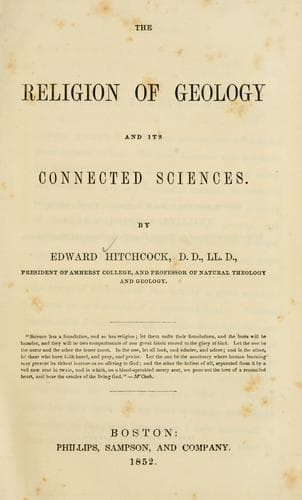
The Religion of Geology and Its Connected SciencesHitchcock, Edward
Religion
The Religion of Geology and Its Connected Sciences
Hitchcock, Edward
Bible and geology; Religion and science
The cosmogony of this theory is embraced in what is denominated the
nebular hypothesis, propounded by the eminent mathematician La Place. He
supposes that, originally, the whole solar system constituted only one
vast mass of nebulous matter, being expanded into the thinnest vapor and
gas by heat, and more than filling the space at present occupied by the
planets. This vapor, he still further supposes, had a revolution from west
to east on an axis. As the heat diminished by radiation, the nebulous
matter must condense, and consequently the velocity of rotation must
increase, and an exterior zone of vapor might be detached; since the
central attraction might not be able to overcome the increased centrifugal
force. This ring of vapor might sometimes retain its original form, as in
the case of Saturn's ring; but the tendency would be, in general, to
divide into several masses, which, by coalescing again, would form a
single mass, having a revolution about the sun, and on its axis. This
would constitute a planet in a state of vapor; and by the detachment of
successive rings might all the planets be produced. As they went on
contracting, by the same law, satellites might be formed to each; and the
ultimate result would be solid planets and satellites, revolving around
the sun in nearly the same plane, and in the same direction, and also on
their axes.
Although this hypothesis has been regarded with favor by many
philosophers, who were Theists, and even Christians, yet the object of La
Place in proposing it was to sustain atheism. Sir Isaac Newton had
expressed the conviction that "the admirable arrangement of the solar
system cannot but be the work of an intelligent and most powerful Being."
La Place declared that, in this statement, Newton "had deviated from the
method of true philosophy," and brought forward these views to sustain his
declaration. Whether they do sustain it, will be considered in another
place. But since it is one of those modes in which men have attempted to
account for the universe without a Deity, it is a proper subject of
examination in this lecture, in which we are inquiring whether law alone
will account for the creation and sustentation of the universe.
Public-domain text, read in full here on John Shaqi.
Reviews
Reviews
No reviews yet
Be the first to share your thoughts on this work.
Elsewhere in the archive
Join the Discussion
Join the discussion
Sign in to leave a comment or review.
Sign InorCreate an account