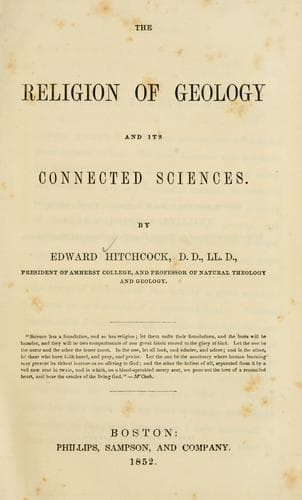
The Religion of Geology and Its Connected SciencesHitchcock, Edward
Religion
The Religion of Geology and Its Connected Sciences
Hitchcock, Edward
Bible and geology; Religion and science
The zoogony of this hypothesis undertakes to show how animals and plants
may be produced without any special exercise of creating power on the part
of the Deity. It supposes matter to be endowed with certain laws, whose
operation alone will determine life in brute matter, or, rather, whose
operation constitutes life. Some would have it that a part of matter is
essentially vital; that is, endowed with inherent life; and that this
matter, like leaven, communicates life to dead matter arranged in a
certain order. But the more modern view is, that life is produced by
electrical agency. It is found that the fundamental form of organic beings
is a globule, having another globule forming within it. It is also found
that globules may be produced in albumen by electricity; and if we could
discover how nature produces albumen, it is thought that the whole process
by which living organisms are produced would be distinctly before us. It
seems to be simply the operation of electricity, and requires no
intervention of special creating energy. If the question arises, Whence
came such marvellous laws to exist in nature? the atheist replies that
matter and its laws are eternal, having neither beginning nor end; while
the Theist, who maintains this hypothesis, asserts that, when God created
matter, he endowed it with such laws, having an inherent, self-executing
power.
Having thus ascertained, as it supposes, how life and organization in the
simplest forms may be produced, the next inquiry is, how the more perfect
and complicated forms of organic beings may be developed by laws, without
divine power. This constitutes the zoonomy of the subject. The French
zoologist, Lamarck, first drew out and formally defended this hypothesis,
aided by others, as Geoffroy St. Hilaire and Bory St. Vincent. Their
supposition was, that there is a power in nature, which they sometimes
denominated the Deity, yet did not allow it to be intelligent and
independent, but a mere blind, instrumental force. This power, they
supposed, was able to produce what they called _monads_, or rough draughts
of animals and plants. These monads were the simplest of all organic
beings, mere aggregations of matter, some of them supposed to be
inherently vital. And such monads are the only things ever produced
directly by this blind deity. But in these monads there was supposed to
reside an inherent tendency to progressive improvement. The wants of this
living mass of jelly were supposed to produce such effects as would
gradually form new organs, as the hands, the feet, and the mouth. These
changes would be aided by another principle, which they called the _force
of external circumstances_, by which they meant the influence upon its
development of its peculiar condition; as, for instance, a conatus for
flying, produced by the internal principle, would form wings in birds; a
conatus for swimming in water would form the fins and tails of fishes; and
Public-domain text, read in full here on John Shaqi.
Reviews
Reviews
No reviews yet
Be the first to share your thoughts on this work.
Elsewhere in the archive
Join the Discussion
Join the discussion
Sign in to leave a comment or review.
Sign InorCreate an account