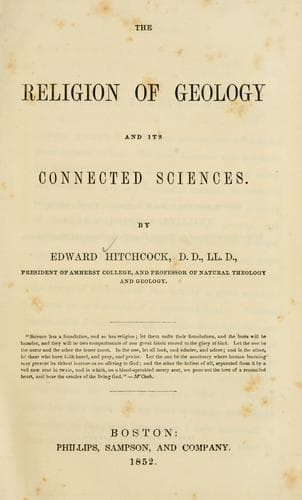
The Religion of Geology and Its Connected SciencesHitchcock, Edward
Religion
The Religion of Geology and Its Connected Sciences
Hitchcock, Edward
Bible and geology; Religion and science
It is very possible, in some cases of this kind, that the soil, having
been produced by aqueous agencies, may contain seeds to a considerable
depth, and that their vitality may have been preserved for centuries; for
we know that seeds three thousand years old, taken from Egyptian
catacombs, have germinated, in favorable circumstances. In most cases of
this sort, however, the winds have probably supplied the seed, it may be,
long before. We were one day wandering over Mount Holyoke, where a spot
recently cleared was covered with the fire-weed, a species of senecio; and
as we were musing upon its origin, a strong blast of wind swept over the
plants, just ready to throw off their seeds. Sustained by their light
egrets, they floated away on the air in numbers sufficient to cover half
the mountain with the plant, when it should be cleared and burnt over. Yet
their existence would never be suspected till those circumstances should
be developed. At least, until we can prove that the soil contains no
seeds by the most careful examination, it will be premature to infer the
equivocal production of the plants growing upon it.
Vegetable physiology furnishes another fact, which seems to me to look
still more favorable to this law hypothesis than the preceding, although
it has not been noticed, so far as I know, by the advocates of that
hypothesis. Speaking of the matter of which certain flowerless plants are
composed, Dr. Lindlay says, "It is even uncertain whether this matter will
produce its like, and whether it is not a mere representation of the vital
principle of vegetation, capable of being called into action, either as a
fungus, or algae, or lichen, according to the particular conditions of
heat, light, and moisture, and the medium in which it is placed; producing
fungi upon dead or putrid organic beings, lichens upon living vegetables,
earth, or stones, and algae where water is the medium in which it is
developed." Again, in speaking of that green slime which often covers the
soil, rocks, walls, and glass in damp places, he says, "The slime
resembles a layer of albumen, spread with a brush; it exfoliates in
drying, and finally becomes visible by the manner in which it colors green
or deep brown. One might call it a provisional creation, waiting to be
organized, and then assuming different forms according to the nature of
the corpuscles which penetrate it, or develop among it. It may further be
said to be the origin of two very distinct existences, the one certainly
animal, the other purely vegetable."--_Natural System_, pp. 326, 328, 334.
Public-domain text, read in full here on John Shaqi.
Reviews
Reviews
No reviews yet
Be the first to share your thoughts on this work.
Elsewhere in the archive
Join the Discussion
Join the discussion
Sign in to leave a comment or review.
Sign InorCreate an account