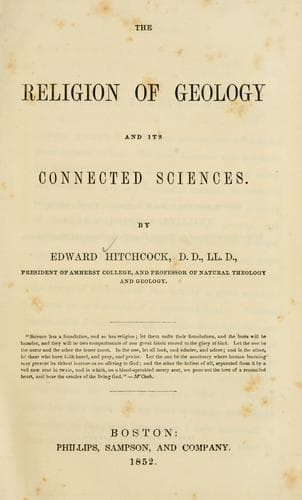
The Religion of Geology and Its Connected SciencesHitchcock, Edward
Religion
The Religion of Geology and Its Connected Sciences
Hitchcock, Edward
Bible and geology; Religion and science
Now, admitting all the facts that have been detailed respecting the
production of infusoria, entozoa, acari, and cryptogamian plants to be
true, although most of them are far from being proved, it seems to me that
they do not show us how vitality is produced by mere law, without the
special agency of the Deity. Writers on the subject seem to overlook the
distinction between organization and life. The first may be present in its
highest perfection without the latter, as it is in animals and plants
recently killed. The organization is merely a preparation to receive the
mysterious principles which we call _life_ and _intellect_. Light, heat,
and electricity may be the essential agents in producing the organization,
but they do not explain the nature, or account for the presence, of life.
That must, so far as we know, come from some other and a higher source.
Galvanism may bring gelatinous matter into the form of an insect, or
infusoria, or entozoa; but there is no evidence that it can impart life,
however exquisite the organization. It may be, and we have reason to
suppose it is, the divine will to bestow life whenever a certain
organization exists; but this does not show that his special agency is not
concerned in it. He may will that the peculiar life of a lichen shall be
given to the same elementary matter which, in another situation, he
constitutes an alga, or a fungus, or even an animal. But this would not
prove that natural law alone could produce life. There is nowhere any
evidence that sensibility, contractility, and especially intellect and
volition, are the result of any natural operations. In their properties
they are so entirely diverse from all known physical effects, that we must
impute them to some other than a natural cause. We must call in the power
of a supreme intelligent Being. The laws of affinity, light, heat, and
electricity, of endosmose and exosmose, may prepare the organization, but
their power ends there; and hence true philosophy requires us to impute
the phenomena of life and intellect to an extraneous and infinitely higher
cause.
The case, then, stands thus: In ninety-nine cases out of a hundred, we
are certain that organization requires the previous existence and agency
of a being similarly organized, which we call the parent. But suppose
that, in a very few cases, the laws of nature can produce the
organization. It still demands another and a higher power--not a blind
impulse, but an intelligent cause--to bestow life and intellect. To prove
the existence of a natural cause for the arrangement of the atoms into an
organic structure, does by no means prove the same for those higher and
mysterious principles that make that structure a living, thinking being.
Public-domain text, read in full here on John Shaqi.
Reviews
Reviews
No reviews yet
Be the first to share your thoughts on this work.
Elsewhere in the archive
Join the Discussion
Join the discussion
Sign in to leave a comment or review.
Sign InorCreate an account