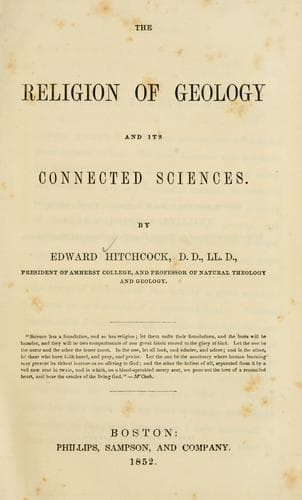
The Religion of Geology and Its Connected SciencesHitchcock, Edward
Religion
The Religion of Geology and Its Connected Sciences
Hitchcock, Edward
Bible and geology; Religion and science
Such, however, are the strongest arguments by which the advocates of the
law hypothesis sustain their views of the origin of organism, life, and
intellect. The next step in their reasoning is to show how animals and
plants may be transmuted from one species, or genus, or family, to
another; so that the existing vast variety can be traced to a few original
germs. They maintain that these developments of the more from the less
perfect have proceeded along certain parallel lines; one series of
developments, for instance, taking the line of the fishes, another of the
reptiles, another of the birds, another of quadrupeds, and so on.
To prove these developments or transmutations, they appeal first to the
physiological history of the mammalian embryo. In its earliest stages, it
can hardly be distinguished, except in size, from the unborn polygastric
infusoria. The brain of a human embryo appears at first like that of an
invertebrate animal; next like that of a fish; then successively like that
of a reptile, a bird, a rodent mammal, a ruminant, and a monkey. So the
heart, at an early stage, looks like that of an insect; then it has two
chambers, like that of a fish; then it becomes three chambered, like that
of a reptile; and finally, four chambered, as in the mammalia. The
inference which these theorists would draw from such facts is, that man
actually begins his existence as an animalcule, and passes successively
through the mould or condition of other animals, before he reaches the
highest. And the reasons why he does become a man, rather than an
echinoderm, or a fish, or a monkey, is only some slightly modifying
circumstance, as, for instance, a longer gestation. It appears to me,
however, that the inferences sound philosophy should derive from such
facts are, first, that, while there is a seeming resemblance between the
human embryo and that of lower animals, there is, in fact, a real and a
wide diversity; so that the one infallibly becomes an inferior animal, and
the other a man. Could a single example be produced in which a human
embryo stopped at and became an insect, or a fish, or a monkey, there
might be some plausibility in the supposition. But it is as certain to
become a man as the sun is to rise and set; and, therefore, the human
condition results from laws as fixed as those that regulate the movements
of the heavenly bodies. That is a very superficial philosophy which infers
identity of nature from mere external resemblance.
Public-domain text, read in full here on John Shaqi.
Reviews
Reviews
No reviews yet
Be the first to share your thoughts on this work.
Elsewhere in the archive
Join the Discussion
Join the discussion
Sign in to leave a comment or review.
Sign InorCreate an account