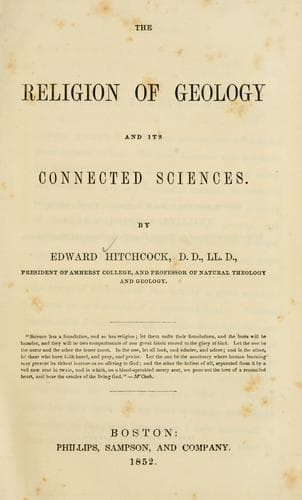
The Religion of Geology and Its Connected SciencesHitchcock, Edward
Religion
The Religion of Geology and Its Connected Sciences
Hitchcock, Edward
Bible and geology; Religion and science
The doctrine, which supposes the Deity to exercise a superintendence and
direction over all the affairs of the universe, in any of the modes that
have been mentioned, whether by a subordinate agent, or by laws, general
or particular, with inherent self-executing power, or by the direct
efficiency of the divine will, is called the doctrine of divine
providence. If the superintendence extend only to general laws, it is
called a general providence. If those laws reach every possible case, it
is called a particular or universal providence.
By a _Miraculous Providence_ is meant a superintendence over the world
that interferes, when desirable, with the regular operations of nature,
and brings about events, either in opposition to natural laws, or by
giving them a less or greater power than usual. In either of these cases,
the events cannot be explained by natural laws; they are above, or
contrary to, nature, and, therefore, are called miracles, or prodigies.
There may be, and, as I believe, there is, another class of occurrences,
intermediate between miracles and events strictly natural. These take
place in perfect accordance with the natural laws within human view, and
appear to us to be perfectly accounted for by those laws; and yet, in some
way or other, we learn that they required some special exercise of divine
power, out of human view, for their production. Thus, according to the
views of most Christian denominations, conversion takes place in the human
heart in perfect accordance with the laws of mind, and could be
philosophically explained by them; yet revelation assures that it _is not
of blood,_ [natural descent,] _nor of the will of the flesh, nor of the
will of man, but of God_. Divine power, therefore, is essential to the
change, although we see only the operation of natural causes. So a storm
may appear to us to be perfectly accounted for by natural laws; and yet
divine efficiency might have produced a change in some of those laws out
of our sight, and thus meet a particular exigency. Such events I call
_special providence_; and I maintain that we cannot tell how frequently
they may occur.
It is chiefly the bearings of science, especially of geology, upon the
doctrine of miraculous and special providence, which I wish to consider.
But it may form a useful introduction, to state the evidence, which goes
to show that the agency of the Deity, in the ordinary operations of
nature, is a direct efficiency; or, in other words, that the laws of
nature are only the modes in which divine agency operates.
In the first place, if we suppose ever so many secondary causes to be
concerned in natural events, the efficiency must, after all, be referred
to God.
Public-domain text, read in full here on John Shaqi.
Reviews
Reviews
No reviews yet
Be the first to share your thoughts on this work.
Elsewhere in the archive
Join the Discussion
Join the discussion
Sign in to leave a comment or review.
Sign InorCreate an account