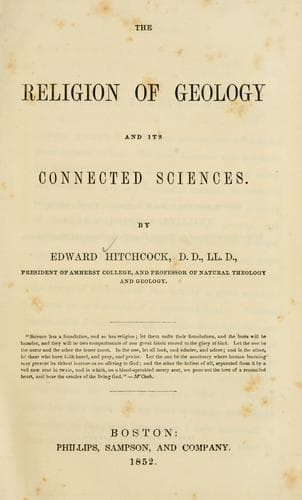
The Religion of Geology and Its Connected SciencesHitchcock, Edward
Religion
The Religion of Geology and Its Connected Sciences
Hitchcock, Edward
Bible and geology; Religion and science
What is a secondary cause? or, in other words, what is a law of nature
considered as a cause? It is simply a uniform mode of operation. We find
that heavy bodies uniformly tend towards the earth's centre, and that we
call the law of gravity; but if those bodies sometimes ascended, and
sometimes moved horizontally, under the same circumstances, we could not
infer the existence of such a law.
Now, there must be some cause for uniformity of operation in nature. There
must be some foreign power, which gives the uniformity, since it is
certain that the law itself can possess no efficiency. We may, indeed,
find one law dependent upon a second law, and this upon a third, and so
on. But the inquiry still arises, What gives the efficiency to this second
and third law? and still the answer must be, Something out of itself. So
that if we run back on the chain of causes ever so far, we must still
resort to the power of the Deity to find any efficiency that will produce
the final result. In most cases, we can trace back only one or two links
on the chain. For instance, we account for the falling of all bodies by
the law of gravity. But philosophers have wearied themselves in vain to
find any cause for gravity, except in the will of God. The failure of
every other hypothesis, though invented by such men as Newton and Le Sage,
has been signal. Sound philosophy, then, requires us to infer that gravity
owes its efficiency to the direct exertion of divine power. And so in all
cases, when we can no longer discover second causes for any phenomenon,
why should we imagine their existence, rather than refer it to the agency
of God? For go back as far as we may, and discover a thousand intervening
causes, the efficiency resides alone in God. We have no evidence that even
infinite power can communicate that efficiency to the laws of nature, so
that they can act without the presence and agency of God. The common idea,
which endows those laws with independent power, will not bear examination.
In the second place, if natural operations do not depend upon the exercise
of divine power, no other efficient cause can be assigned for their
production.
Public-domain text, read in full here on John Shaqi.
Reviews
Reviews
No reviews yet
Be the first to share your thoughts on this work.
Elsewhere in the archive
Join the Discussion
Join the discussion
Sign in to leave a comment or review.
Sign InorCreate an account