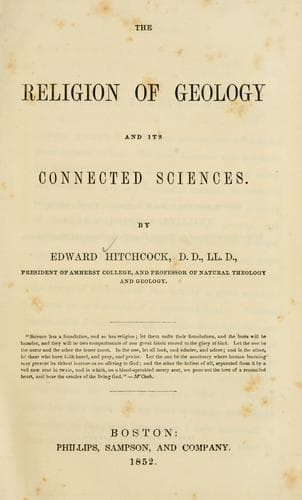
The Religion of Geology and Its Connected SciencesHitchcock, Edward
Religion
The Religion of Geology and Its Connected Sciences
Hitchcock, Edward
Bible and geology; Religion and science
We have seen that in the laws of nature, independently of the Deity, there
is no efficiency; and I know not where else we can resort for any agency
to carry forward the operations of nature, except to the same infinite
Being. The fate and chance of the ancients, the plastic nature of
Cudworth, the delegated nature of Lamarck, are indeed names invented by
men to designate a certain imaginary efficiency residing somewhere,
independent of the Deity, by which the phenomena of nature have been
supposed to be produced. But the moment they are described, they are found
to be mere imaginary agencies, meaning nothing more than the course of
nature, or the laws of nature, which we have seen possess no independent
efficiency. To a divine agency, therefore, we must resort, or be left
without any adequate cause for the complicated and wonderful processes of
nature.
In the third place, this view of the subject is strongly confirmed by the
Christian Scriptures.
How universal is the divine agency represented in the well-known
passage--_for of him, and through him, and to him, are all things_.
Equally vivid is Paul's statement on Mars Hill--_In him we live, and move,
and have our being._ How graphic a description is the 147th Psalm of God's
agency in the natural world! Not only is all good ascribed to God, but
evil also. By the mouth of Isaiah he says, _I form light and create
darkness; I make peace and create evil; I the Lord do all these things._
In short, no event in the material or spiritual world is by the sacred
writers ascribed to chance, or to nature, or the laws of nature, as it is
among men; but to the direct efficiency of God. Nor is there any
difference in this respect between miracles and common events. The one
class is represented as originating in the agency of God, just as much as
the other.
Finally. It will hardly be thought strange, in view of the preceding
considerations, that a large proportion of the most acute and
philosophical minds in modern times have preferred this view of divine
providence to any other.
Sir Isaac Newton declares that the various parts of the world, organic and
inorganic, "can be the effect of nothing else than the wisdom and skill of
a powerful, ever-living Agent, who, being in all places, is more able by
his will to move the bodies within his boundless, uniform _sensorium_,
thereby to form and reform the parts of the universe, than we are by our
will to move the parts of our own bodies."
Says Dr. Clarke, the friend and disciple of Newton, "All things which we
commonly say are the effects of the natural powers of matter, and laws of
motion, are, indeed, if we will speak strictly and properly, the effects
of God's action upon matter continually, and at every moment, either
immediately by himself, or mediately by some created, intelligent being.
Consequently there is no such thing as the course of nature, or the power
of nature, independent of the effects produced by the will of God."
Public-domain text, read in full here on John Shaqi.
Reviews
Reviews
No reviews yet
Be the first to share your thoughts on this work.
Elsewhere in the archive
Join the Discussion
Join the discussion
Sign in to leave a comment or review.
Sign InorCreate an account