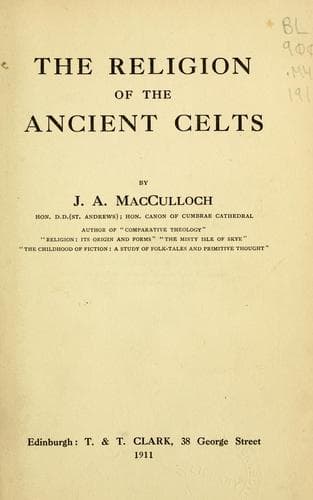
The Religion of the Ancient CeltsMacCulloch, J. A. (John Arnott)
Religion
The Religion of the Ancient Celts
MacCulloch, J. A. (John Arnott)
Celts -- Religion; Mythology, Celtic
During the _Táin_, Cúchulainn slaughtered the wizard Calatin and his
daughters. But Calatin's wife bore three posthumous sons and three
daughters, and through their means the hero was at last slain.
Everything was done to keep him back from the host which now advanced
against Ulster, but finally one of Calatin's daughters took the form of
Niamh and bade him go forth. As he passed to the fight, Calatin's
daughters persuaded him to eat the flesh of a dog--a fatal deed, for it
was one of his _geasa_ never to eat dog's flesh. So it was that in the
fight he was slain by Lugaid,[463] and his soul appeared to the thrice
fifty queens who had loved him, chanting a mystic song of the coming of
Christ and the day of doom--an interesting example of a phantasm
coincidental with death.[464] This and other Christian touches show that
the Christian redactors of the saga felt tenderly towards the old pagan
hero. This is even more marked in the story in which he appears to King
Loegaire and S. Patrick, begging the former to believe in God and the
saint, and praying Patrick to "bring me with thy faithful ones unto the
land of the living."[465] A similar Christianising appears in the story
of Conchobar's death, the result of his mad frenzy on hearing from his
Druid that an earthquake is the result of the shameful crucifixion of
Christ.[466]
In the saga, Cúchulainn appears as the ideal Celtic warrior, but, like
other ideal warriors, he is a "magnified, non-natural man," many of his
deeds being merely exaggerations of those common among barbaric folk.
Even his "distortion" or battle frenzy is but a magnifying of the wild
frenzy of all wild fighters. To the person of this ideal warrior, some
of whose traits may have been derived from traditional stories of actual
heroes, _Märchen_ and saga episodes attached themselves. Of every ideal
hero, Celtic, Greek, Babylonian, or Polynesian, certain things are
told--his phenomenal strength as a child; his victory over enormous
forces; his visits to the Other-world; his amours with a goddess; his
divine descent. These belong to the common stock of folk-tale episodes,
and accumulate round every great name. Hence, save in the colouring
given to them or the use made of them by any race, they do not afford a
key to the mythic character of the hero. Such deeds are ascribed to
Cúchulainn, as they doubtless were to the ideal heroes of the "undivided
Aryans," but though parallels may be found between him and the Greek
Heracles, they might just as easily be found in non-Aryan regions, e.g.
in Polynesia. Thus the parallels between Cúchulainn and Heracles throw
little light on the personality of the former, though here and there in
such parallels we observe a peculiarly Celtic touch. Thus, while the
Greek hero rescues Hesione from a dragon, it is from three Fomorians
that Cúchulainn rescues Devorgilla, namely, from beings to whom actual
human sacrifice was paid. Thus a _Märchen_ formula of world-wide
Public-domain text, read in full here on John Shaqi.
Reviews
Reviews
No reviews yet
Be the first to share your thoughts on this work.
Elsewhere in the archive
Join the Discussion
Join the discussion
Sign in to leave a comment or review.
Sign InorCreate an account