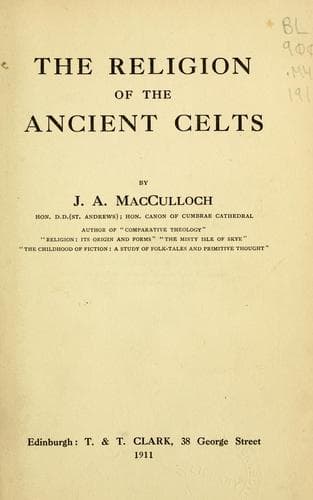
The Religion of the Ancient CeltsMacCulloch, J. A. (John Arnott)
Religion
The Religion of the Ancient Celts
MacCulloch, J. A. (John Arnott)
Celts -- Religion; Mythology, Celtic
Scrutiny reveals the fact that Celtic-speaking peoples are of differing
types--short and dark as well as tall and fairer Highlanders or
Welshmen, short, broad-headed Bretons, various types of Irishmen. Men
with Norse names and Norse aspect "have the Gaelic." But all alike have
the same character and temperament, a striking witness to the influence
which the character as well as the language of the Celts, whoever they
were, made on all with whom they mingled. Ethnologically there may not
be a Celtic race, but something was handed down from the days of
comparative Celtic purity which welded different social elements into a
common type, found often where no Celtic tongue is now spoken. It
emerges where we least expect it, and the stolid Anglo-Saxon may
suddenly awaken to something in himself due to a forgotten Celtic strain
in his ancestry.
Two main theories of Celtic origins now hold the field:
(1) The Celts are identified with the progenitors of the short,
brachycephalic "Alpine race" of Central Europe, existing there in
Neolithic times, after their migrations from Africa and Asia. The type
is found among the Slavs, in parts of Germany and Scandinavia, and in
modern France in the region of Cæsar's "Celtæ," among the Auvergnats,
the Bretons, and in Lozère and Jura. Representatives of the type have
been found in Belgian and French Neolithic graves.[6] Professor Sergi
calls this the "Eurasiatic race," and, contrary to general opinion,
identifies it with the Aryans, a savage people, inferior to the
dolichocephalic Mediterranean race, whose language they Aryanised.[7]
Professor Keane thinks that they were themselves an Aryanised folk
before reaching Europe, who in turn gave their acquired Celtic and
Slavic speech to the preceding masses. Later came the Belgæ, Aryans, who
acquired the Celtic speech of the people they conquered.[8]
Broca assumed that the dark, brachycephalic people whom he identified
with Cæsar's "Celtæ," differed from the Belgæ, were conquered by them,
and acquired the language of their conquerors, hence wrongly called
Celtic by philologists. The Belgæ were tall and fair, and overran Gaul,
except Aquitaine, mixing generally with the Celtæ, who in Cæsar's time
had thus an infusion of Belgic blood.[9] But before this conquest, the
Celtæ had already mingled with the aboriginal dolichocephalic folk of
Gaul, Iberians, or Mediterraneans of Professor Sergi. The latter had
apparently remained comparatively pure from admixture in Aquitaine, and
are probably the Aquitani of Cæsar.[10]
Public-domain text, read in full here on John Shaqi.
Reviews
Reviews
No reviews yet
Be the first to share your thoughts on this work.
Join the Discussion
Join the discussion
Sign in to leave a comment or review.
Sign InorCreate an account