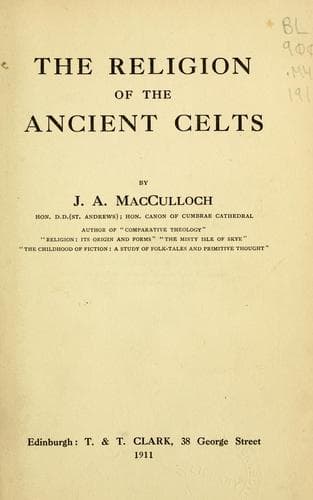
The Religion of the Ancient CeltsMacCulloch, J. A. (John Arnott)
Religion
The Religion of the Ancient Celts
MacCulloch, J. A. (John Arnott)
Celts -- Religion; Mythology, Celtic
Our knowledge of the higher side of Celtic religion is practically a
blank, since no description of the inner spiritual life has come down to
us. How far the Celts cultivated religion in our sense of the term, or
had glimpses of Monotheism, or were troubled by a deep sense of sin, is
unknown. But a people whose spiritual influence has later been so great,
must have had glimpses of these things. Some of them must have known the
thirst of the soul for God, or sought a higher ethical standard than
that of their time. The enthusiastic reception of Christianity, the
devotion of the early Celtic saints, and the character of the old Celtic
church, all suggest this.
The relation of the Celtic church to paganism was mainly intolerant,
though not wholly so. It often adopted the less harmful customs of the
past, merging pagan festivals in its own, founding churches on the sites
of the old cult, dedicating sacred wells to a saint. A saint would visit
the tomb of a pagan to hear an old epic rehearsed, or would call up
pagan heroes from hell and give them a place in paradise. Other saints
recall dead heroes from the Land of the Blessed, and learn the nature of
that wonderland and the heroic deeds
"Of the old days, which seem to be
Much older than any history
That is written in any book."
Reading such narratives, we gain a lesson in the fine spirit of
Christian tolerance and Christian sympathy.
FOOTNOTES:
[2] Some writers saw in the bardic poetry a Druidic-esoteric system and
traces of a cult practised secretly by the bards--the "Neo-Druidic
heresy"; see Davies, _Myth. of the Brit. Druids_, 1809; Herbert, _The
Neo-Druidic Heresy_, 1838. Several French writers saw in "Druidism" a
monotheistic faith, veiled under polytheism.
[3] Livy, v. 46; Cæsar, vi. 16; Dion. Hal. vii. 70; Arrian, _Cyneg_.
xxxv. 1.
[4] Cæsar, vi. 15, cf. v. 12, "having waged war, remained there and
cultivated the lands."
[5] Cf. Pliny, _HN_ xvii. 7, xviii. 18 on the wheeled ploughs and
agricultural methods of Gauls and Britons. Cf. also Strabo, iv. 1. 2,
iv. 5. 5; Girald. Camb. _Top. Hib._ i. 4, _Descr. Camb._ i. 8; Joyce,
_SH_ ii. 264.
CHAPTER II.
THE CELTIC PEOPLE.
Public-domain text, read in full here on John Shaqi.
Reviews
Reviews
No reviews yet
Be the first to share your thoughts on this work.
Join the Discussion
Join the discussion
Sign in to leave a comment or review.
Sign InorCreate an account