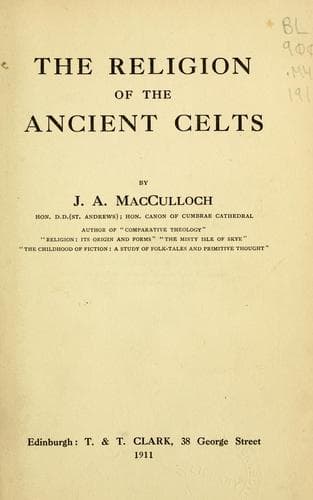
The Religion of the Ancient CeltsMacCulloch, J. A. (John Arnott)
Religion
The Religion of the Ancient Celts
MacCulloch, J. A. (John Arnott)
Celts -- Religion; Mythology, Celtic
[509] In a widespread group of tales supernatural knowledge is obtained
by eating part of some animal, usually a certain snake. In many of these
tales the food is eaten by another person than he who obtained it, as in
the case of Fionn. Cf. the Welsh story of Gwion, p. 116, and the
Scandinavian of Sigurd, and other parallels in Miss Cox, _Cinderella_,
496; Frazer, _Arch. Rev._ i. 172 f. The story is thus a folk-tale
formula applied to Fionn, doubtless because it harmonised with Celtic or
pre-Celtic totemistic ideas. But it is based on ancient ideas regarding
the supernatural knowledge possessed by reptiles or fish, and among
American Indians, Maoris, Solomon Islanders, and others there are
figured representations of a man holding such an animal, its tongue
being attached to his tongue. He is a _shaman_, and American Indians
believe that his inspiration comes from the tongue of a mysterious river
otter, caught by him. See Dall, _Bureau of Ethnol._ 3rd report; and Miss
Buckland, _Jour. Anth. Inst._ xxii. 29.
[510] _TOS_ iv.; O'Curry, _MS. Mat._ 396; Joyce, _OCR_ 194, 339.
[511] For ballad versions see Campbell, _LF_ 198.
[512] Numerous ballad versions are given in Campbell _LF_ 152 f. The
tale is localised in various parts of Ireland and the Highlands, many
dolmens in Ireland being known as Diarmaid and Grainne's beds.
[513] For an account differing from this annalistic version, see _ZCP_
i. 465.
[514] O'Grady, ii. 102. This, on the whole, agrees with the Highland
ballad version, _LF_ 198.
[515] _IT_ iv.; O'Grady, _Silva Gad._ text and translation.
CHAPTER IX.
GODS AND MEN.
Public-domain text, read in full here on John Shaqi.
Reviews
Reviews
No reviews yet
Be the first to share your thoughts on this work.
Elsewhere in the archive
Join the Discussion
Join the discussion
Sign in to leave a comment or review.
Sign InorCreate an account