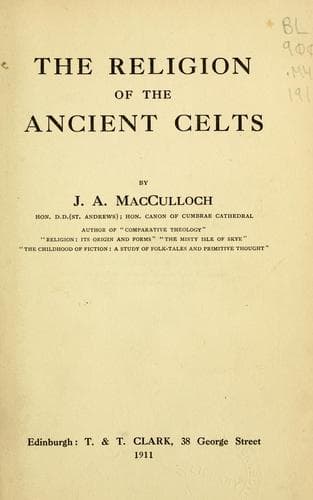
The Religion of the Ancient CeltsMacCulloch, J. A. (John Arnott)
Religion
The Religion of the Ancient Celts
MacCulloch, J. A. (John Arnott)
Celts -- Religion; Mythology, Celtic
Though man usually makes his gods in his own image, they are unlike as
well as like him. Intermediate between them and man are ideal heroes
whose parentage is partly divine, and who may themselves have been gods.
One mark of the Celtic gods is their great stature. No house could
contain Bran, and certain divine people of Elysium who appeared to Fionn
had rings "as thick as a three-ox goad."[516] Even the Fians are giants,
and the skull of one of them could contain several men. The gods have
also the attribute of invisibility, and are only seen by those to whom
they wish to disclose themselves, or they have the power of concealing
themselves in a magic mist. When they appear to mortals it is usually in
mortal guise, sometimes in the form of a particular person, but they can
also transform themselves into animal shapes, often that of birds. The
animal names of certain divinities show that they had once been animals
pure and simple, but when they became anthropomorphic, myths would arise
telling how they had appeared to men in these animal shapes. This, in
part, accounts for these transformation myths. The gods are also
immortal, though in myth we hear of their deaths. The Tuatha Dé Danann
are "unfading," their "duration is perennial."[517] This immortality is
sometimes an inherent quality; sometimes it is the result of eating
immortal food--Manannan's swine, Goibniu's feast of age and his immortal
ale, or the apples of Elysium. The stories telling of the deaths of the
gods in the annalists may be based on old myths in which they were said
to die, these myths being connected with ritual acts in which the human
representatives of gods were slain. Such rites were an inherent part of
Celtic religion. Elsewhere the ritual of gods like Osiris or Adonis,
based on their functions as gods of vegetation, was connected with
elaborate myths telling of their death and revival. Something akin to
this may have occurred among the Celts.
Public-domain text, read in full here on John Shaqi.
Reviews
Reviews
No reviews yet
Be the first to share your thoughts on this work.
Elsewhere in the archive
Join the Discussion
Join the discussion
Sign in to leave a comment or review.
Sign InorCreate an account