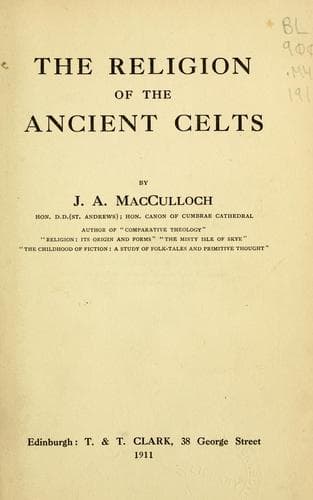
The Religion of the Ancient CeltsMacCulloch, J. A. (John Arnott)
Religion
The Religion of the Ancient Celts
MacCulloch, J. A. (John Arnott)
Celts -- Religion; Mythology, Celtic
But do a few hundred skulls justify these far-reaching conclusions
regarding races enduring for thousands of years? At some very remote
period there may have been a Celtic type, as at some further period
there may have been an Aryan type. But the Celts, as we know them, must
have mingled with the aborigines of Europe and become a mixed race,
though preserving and endowing others with their racial and mental
characteristics. Some Gauls or Belgæ were dolichocephalic, to judge by
their skulls, others were brachycephalic, while their fairness was a
relative term. Classical observers probably generalised from the higher
classes, of a purer type; they tell us nothing of the people. But the
higher classes may have had varying skulls, as well as stature and
colour of hair,[24] and Irish texts tell of a tall, fair, blue-eyed
stock, and a short, dark, dark-eyed stock, in Ireland. Even in those
distant ages we must consider the people on whom the Celts impressed
their characteristics, as well as the Celts themselves. What happened on
the Eurasian steppe, the hypothetical cradle of the "Aryans," whence the
Celts came "stepping westwards," seems clear to some, but in truth is a
book sealed with seven seals. The men whose Aryan speech was to dominate
far and wide may already have possessed different types of skull, and
that age was far from "the very beginning."
Thus the Celts before setting out on their _Wanderjahre_ may already
have been a mixed race, even if their leaders were of purer stock. But
they had the bond of common speech, institutions, and religion, and they
formed a common Celtic type in Central and Western Europe. Intermarriage
with the already mixed Neolithic folk of Central Europe produced further
removal from the unmixed Celtic racial type; but though both reacted on
each other as far as language, custom, and belief were concerned, on the
whole the Celtic elements predominated in these respects. The Celtic
migration into Gaul produced further racial mingling with descendants of
the old palæolithic stock, dolichocephalic Iberians and Ligurians, and
brachycephalic swarthy folk (Broca's Celts). Thus even the first Celtic
arrivals in Britain, the Goidels, were a people of mixed race, though
probably relatively purer than the late coming Brythons, the latest of
whom had probably mingled with the Teutons. Hence among Celtic-speaking
folk or their descendants--short, dark, broad-beaded Bretons, tall, fair
or rufous Highlanders, tall chestnut-haired Welshmen or Irishmen,
Highlanders of Norse descent, short, dark, narrow-headed Highlanders,
Irishmen, and Welshmen--there is a common Celtic _facies_, the result of
old Celtic characteristics powerful enough so to impress themselves on
such varied peoples in spite of what they gave to the Celtic incomers.
These peoples became Celtic, and Celtic in speech and character they
have remained, even where ancestral physical types are reasserting
themselves.
Public-domain text, read in full here on John Shaqi.
Reviews
Reviews
No reviews yet
Be the first to share your thoughts on this work.
Join the Discussion
Join the discussion
Sign in to leave a comment or review.
Sign InorCreate an account