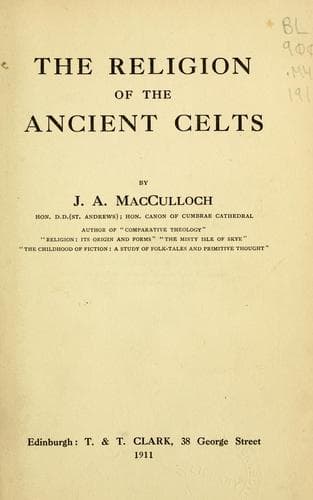
The Religion of the Ancient CeltsMacCulloch, J. A. (John Arnott)
Religion
The Religion of the Ancient Celts
MacCulloch, J. A. (John Arnott)
Celts -- Religion; Mythology, Celtic
The folk of a Celtic type, whether pre-Celtic, Celtic, or
Norse, have all spoken a Celtic language and exhibit the same old Celtic
characteristics--vanity, loquacity, excitability, fickleness,
imagination, love of the romantic, fidelity, attachment to family ties,
sentimental love of their country, religiosity passing over easily to
superstition, and a comparatively high degree of sexual morality. Some
of these traits were already noted by classical observers.
Celtic speech had early lost the initial _p_ of old Indo-European
speech, except in words beginning with _pt_ and, perhaps, _ps_. Celtic
_pare_ (Lat. _præ_) became _are_, met with in _Aremorici_, "the dwellers
by the sea," _Arecluta_, "by the Clyde," the region watered by the
Clyde. Irish _athair_, Manx _ayr_, and Irish _iasg_, represent
respectively Latin _pater_ and _piscis_. _P_ occurring between vowels
was also lost, e.g. Irish _caora_, "sheep," is from _kaperax_; _for_,
"upon" (Lat. _super_), from _uper_. This change took place before the
Goidelic Celts broke away and invaded Britain in the tenth century B.C.,
but while Celts and Teutons were still in contact, since Teutons
borrowed words with initial _p_, e.g. Gothic _fairguni_, "mountain,"
from Celtic _percunion_, later _Ercunio_, the Hercynian forest. The loss
must have occurred before 1000 B.C. But after the separation of the
Goidelic group a further change took place. Goidels preserved the sound
represented by _qu_, or more simply by _c_ or _ch_, but this was changed
into _p_ by the remaining continental Celts, who carried with them into
Gaul, Spain, Italy, and Britain (the Brythons) words in which _q_ became
_p_. The British _Epidii_ is from Gaulish _epos_, "horse," which is in
Old Irish _ech_ (Lat. _equus_). The Parisii take their name from
_Qarisii_, the Pictones or Pictavi of Poictiers from _Pictos_ (which in
the plural _Pidi_ gives us "Picts"), derived from _quicto_. This change
took place after the Goidelic invasion of Britain in the tenth century
B.C. On the other hand, some continental Celts may later have regained
the power of pronouncing _q_. In Gaul the _q_ of _Sequana_ (Seine) was
not changed to _p_, and a tribe dwelling on its banks was called the
Sequani. This assumes that Sequana was a pre-Celtic word, possibly
Ligurian.[25] Professor Rh[^y]s thinks, however, that Goidelic tribes,
identified by him with Cæsar's Celtæ, existed in Gaul and Spain before
the coming of the Galli, and had preserved _q_ in their speech. To them
we owe Sequana, as well as certain names with _q_ in Spain.[26] This at
least is certain, that Goidelic Celts of the _q_ group occupied Gaul and
Spain before reaching Britain and Ireland. Irish tradition and
archæological data confirm this.[27] But whether their descendants were
represented by Cæsar's "Celtæ" must be uncertain. Celtæ and Galli,
according to Cæsar, were one and the same,[28] and must have had the
same general form of speech.
Public-domain text, read in full here on John Shaqi.
Reviews
Reviews
No reviews yet
Be the first to share your thoughts on this work.
Join the Discussion
Join the discussion
Sign in to leave a comment or review.
Sign InorCreate an account