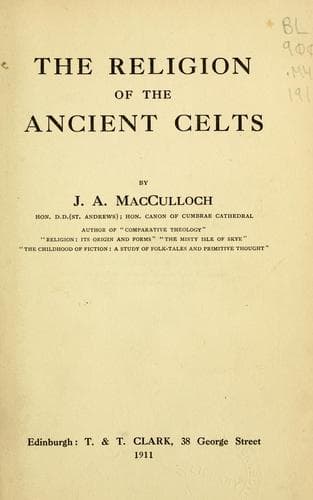
The Religion of the Ancient CeltsMacCulloch, J. A. (John Arnott)
Religion
The Religion of the Ancient Celts
MacCulloch, J. A. (John Arnott)
Celts -- Religion; Mythology, Celtic
round the descendants of Etain--fathers unite with daughters, a son with
his mother, a woman has a son by her three brothers (just as Ecne was
son of Brian, Iuchar, and Iucharba), and is also mother of Crimthan by
that son.[761] Brother and sister unions occur both in Irish and Welsh
story.[762]
In these cases incest with a mother cannot be explained by totemic
usage, but the cases may be distorted reminiscences of what might occur
under totemism, namely, a son taking the wives of his father other than
his own mother, when those were of a different totem from his own. Under
totemism, brothers and sisters by different mothers having different
totems, might possibly unite, and such unions are found in many
mythologies. Later, when totemism passed away, the unions, regarded with
horror, would be supposed to take place between children by the same
mother. According to totem law, a father might unite with his daughter,
since she was of her mother's totem, but in practice this was frowned
upon. Polygamy also may co-exist with totemism, and of course involves
the counting of descent through the mother as a rule. If, as is
suggested by the "debility" of the Ultonians, and by other evidence, the
couvade was a Celtic institution, this would also point to the existence
of the matriarchate with the Celts. To explain all this as pre-Aryan, or
to say that the classical notices refer to non-Aryan tribes and that the
evidence in the Irish sagas only shows that the Celts had been
influenced by the customs of aboriginal tribes among whom they
lived,[763] is to neglect the fact that the customs are closely bound up
with Celtic life, while it leaves unexplained the influence of such
customs upon a people whose own customs, according to this theory, were
so totally different. The evidence, taken as a whole, points to the
existence of totemism among the early Celts, or, at all events, of the
elements which elsewhere compose it.
* * * * *
Public-domain text, read in full here on John Shaqi.
Reviews
Reviews
No reviews yet
Be the first to share your thoughts on this work.
Elsewhere in the archive
Join the Discussion
Join the discussion
Sign in to leave a comment or review.
Sign InorCreate an account