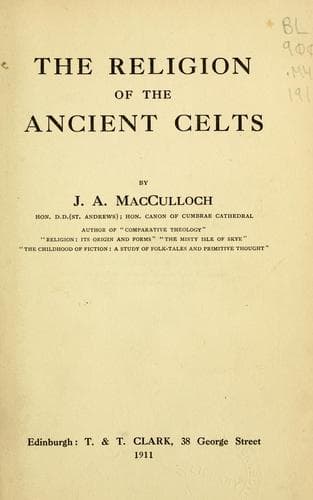
The Religion of the Ancient CeltsMacCulloch, J. A. (John Arnott)
Religion
The Religion of the Ancient Celts
MacCulloch, J. A. (John Arnott)
Celts -- Religion; Mythology, Celtic
In the Stone Age, as with many savages, a circle typified the sun, and
as soon as the wheel was invented its rolling motion at once suggested
that of the sun. In the _Edda_ the sun is "the beautiful, the shining
wheel," and similar expressions occur in the _Vedas_. Among the Celts
the wheel of the sun was a favourite piece of symbolism, and this is
seen in various customs at the Midsummer festival. A burning wheel was
rolled down a slope or trundled through the fields, or burning brands
were whirled round so as to give the impression of a fiery wheel. The
intention was primarily to imitate the course of the sun through the
heavens, and so, on the principle of imitative magic, to strengthen it.
But also, as the wheel was rolled through the fields, so it was hoped
that the direct beneficial action of the sun upon them would follow.
Similar rites might be performed not only at Midsummer, but at other
times, to procure blessing or to ward off evil, e.g. carrying fire round
houses or fields or cattle or round a child _deiseil_ or sunwise,[938]
and, by a further extension of thought, the blazing wheel, or the
remains of the burning brands thrown to the winds, had also the effect
of carrying off accumulated evils.[939]
Beltane and Midsummer thus appear as twin halves of a spring or early
summer festival, the intention of which was to promote fertility and
health. This was done by slaying the spirit of vegetation in his
representative--tree, animal, or man. His death quickened the energies
of earth and man. The fire also magically assisted the course of the
sun. Survival of the ancient rites are or were recently found in all
Celtic regions, and have been constantly combated by the Church. But
though they were continued, their true meaning was forgotten, and they
were mainly performed for luck or out of sheer conservatism. Sometimes a
Christian aspect was given to them, e.g. by connecting the fires with S.
John, or by associating the rites with the service of the Church, or by
the clergy being present at them. But their true nature was still
evident as acts of pagan worship and magic which no veneer of
Christianity could ever quite conceal.[940]
LUGNASAD.
Public-domain text, read in full here on John Shaqi.
Reviews
Reviews
No reviews yet
Be the first to share your thoughts on this work.
Elsewhere in the archive
Join the Discussion
Join the discussion
Sign in to leave a comment or review.
Sign InorCreate an account