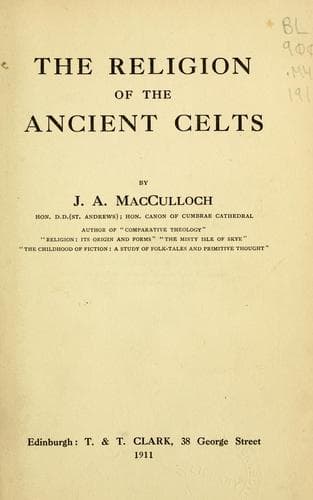
The Religion of the Ancient CeltsMacCulloch, J. A. (John Arnott)
Religion
The Religion of the Ancient Celts
MacCulloch, J. A. (John Arnott)
Celts -- Religion; Mythology, Celtic
M. D'Arbois maintains that, as a result of persecution, the Druids
retired to the depths of the forests, and continued to teach there in
secret those who despised the new learning of Rome, basing his opinion
on passages of Lucan and Mela, both writing a little after the
promulgation of the laws.[1074]. But neither Lucan nor Mela refer to an
existing state of things, and do not intend their readers to suppose
that the Druids fled to woods and caverns. Lucan speaks of them
_dwelling_ in woods, i.e. their sacred groves, and resuming their rites
after Cæsar's conquest not after the later edicts, and he does not speak
of the Druids teaching there.[1075] Mela seems to be echoing Cæsar's
account of the twenty years' novitiate, but adds to it that the teaching
was given in secret, confusing it, however, with that given to others
than candidates for the priesthood. Thus he says: "Docent multa
nobilissimos gentis clam et diu vicenis annis aut in specu aut in
abditis saltibus,"[1076] but there is not the slightest evidence that
this secrecy was the result of the edicts. Moreover, the attenuated
sacrificial rites which he describes were evidently practised quite
openly. Probably some Druids continued their teaching in their secret
and sacred haunts, but it is unlikely that noble Gauls would resort to
them when Greco-Roman culture was now open to them in the schools, where
they are found receiving instruction in 21 A.D.[1077] Most of the Druids
probably succumbed to the new order of things. Some continued the old
rites in a modified manner as long as they could obtain worshippers.
Others, more fanatical, would suffer from the law when they could not
evade its grasp. Some of these revolted against Rome after Nero's death,
and it was perhaps to this class that those Druids belonged who
prophesied the world-empire of the Celts in 70 A.D.[1078] The fact that
Druids existed at this date shows that the proscription had not been
complete. But the complete Romanising of Gaul took away their
occupation, though even in the fourth century men still boasted of their
Druidic descent.[1079]
Public-domain text, read in full here on John Shaqi.
Reviews
Reviews
No reviews yet
Be the first to share your thoughts on this work.
Elsewhere in the archive
Join the Discussion
Join the discussion
Sign in to leave a comment or review.
Sign InorCreate an account