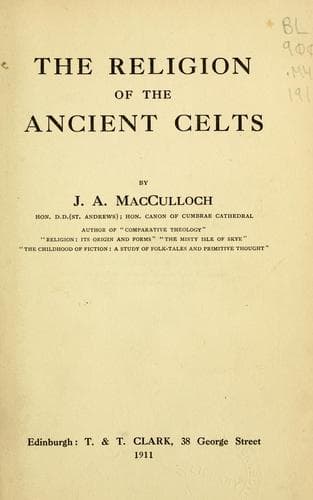
The Religion of the Ancient CeltsMacCulloch, J. A. (John Arnott)
Religion
The Religion of the Ancient Celts
MacCulloch, J. A. (John Arnott)
Celts -- Religion; Mythology, Celtic
The insular Druids opposed the legions in Southern Britain, and in Mona
in 62 A.D. they made a last stand with the warriors against the Romans,
gesticulating and praying to the gods. But with the establishment of
Roman power in Britain their fate must have resembled that of the Druids
of Gaul. A recrudescence of Druidism is found, however, in the presence
of _magi_ (Druids) with Vortigern after the Roman withdrawal.[1080]
Outside the Roman pale the Druids were still rampant and practised their
rites as before, according to Pliny.[1081] Much later, in the sixth
century, they opposed Christian missionaries in Scotland, just as in
Ireland they opposed S. Patrick and his monks, who combated "the
hard-hearted Druids." Finally, Christianity was victorious and the
powers of the Druids passed in large measure to the Christian clergy or
remained to some extent with the _Filid_.[1082] In popular belief the
clerics had prevailed less by the persuasive power of the gospel, than
by successfully rivalling the magic of the Druids.
Classical writers speak of _Dryades_ or "Druidesses" in the third
century. One of them predicted his approaching death to Alexander
Severus, another promised the empire to Diocletian, others were
consulted by Aurelian.[1083] Thus they were divineresses, rather than
priestesses, and their name may be the result of misconception, unless
they assumed it when Druids no longer existed as a class. In Ireland
there were divineresses--_ban-filid_ or _ban-fáthi_, probably a distinct
class with prophetic powers. Kings are warned against "pythonesses" as
well as Druids, and Dr. Joyce thinks these were Druidesses.[1084] S.
Patrick also armed himself against "the spells of women" and of
Druids.[1085] Women in Ireland had a knowledge of futurity, according to
Solinus, and the women who took part with the Druids like furies at
Mona, may have been divineresses.[1086] In Ireland it is possible that
such women were called "Druidesses," since the word _ban-drui_ is met
with, the women so called being also styled _ban-fili_, while the fact
that they belonged to the class of the _Filid_ brings them into
connection with the Druids.[1087] But _ban-drui_ may have been applied
to women with priestly functions, such as certainly existed in
Ireland--e.g. the virgin guardians of sacred fires, to whose functions
Christian nuns succeeded.[1088] We know also that the British queen
Boudicca exercised priestly functions, and such priestesses, apart from
the _Dryades_, existed among the continental Celts. Inscriptions at
Arles speak of an _antistita deae_, and at Le Prugnon of a _flaminica
sacerdos_ of the goddess Thucolis.[1089] These were servants of a
goddess like the priestess of the Celtic Artemis in Galatia, in whose
family the priesthood was hereditary.[1090] The virgins called
Gallizenæ, who practised divination and magic in the isle of Sena, were
priestesses of a Gaulish god, and some of the women who were "possessed
Public-domain text, read in full here on John Shaqi.
Reviews
Reviews
No reviews yet
Be the first to share your thoughts on this work.
Elsewhere in the archive
Join the Discussion
Join the discussion
Sign in to leave a comment or review.
Sign InorCreate an account