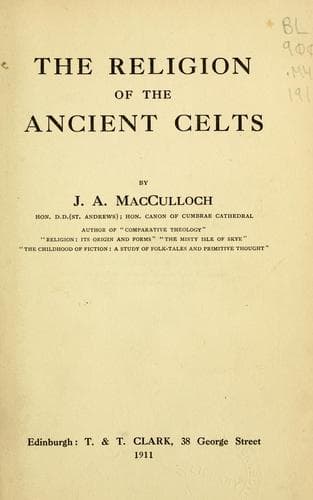
The Religion of the Ancient CeltsMacCulloch, J. A. (John Arnott)
Religion
The Religion of the Ancient Celts
MacCulloch, J. A. (John Arnott)
Celts -- Religion; Mythology, Celtic
by Dionysus" and practised an orgiastic cult on an island in the Loire,
were probably of the same kind.[1091] They were priestesses of some
magico-religious cult practised by women, like the guardians of the
sacred fire in Ireland, which was tabu to men. M. Reinach regards the
accounts of these island priestesses as fictions based on the story of
Circe's isle, but even if they are garbled, they seem to be based on
actual observation and are paralleled from other regions.[1092]
The existence of such priestesses and divineresses over the Celtic area
is to be explained by our hypothesis that many Celtic divinities were at
first female and served by women, who were possessed of the tribal lore.
Later, men assumed their functions, and hence arose the great
priesthoods, but conservatism sporadically retained such female cults
and priestesses, some goddesses being still served by women--the
Galatian Artemis, or the goddesses of Gaul, with their female servants.
Time also brought its revenges, for when paganism passed away, much of
its folk-ritual and magic remained, practised by wise women or witches,
who for generations had as much power over ignorant minds as the
Christian priesthood. The fact that Cæsar and Tacitus speak of Germanic
but not of Celtic priestesses, can hardly, in face of these scattered
notices, be taken as a proof that women had no priestly _rôle_ in Celtic
religion. If they had not, that religion would be unique in the world's
history.
FOOTNOTES:
[1002] Pliny, _HN_ xvi. 249.
[1003] D'Arbois, _Les Druides_, 85, following Thurneysen.
[1004] D'Arbois, _op. cit._ 12 f.; Deloche, _Revue des Deux Mondes_,
xxxiv. 466; Desjardins, _Geog. de la Gaule Romaine_, ii. 518.
[1005] Cæsar, vi. 13.
[1006] Pliny, _HN_ xxx. 1.
[1007] Rh[^y]s, _CB_{4} 69 f.
[1008] Gomme, _Ethnol. in Folk-lore_, 58, _Village Community_, 104.
[1009] Sergi, _The Mediterranean Race_, 295.
[1010] Reinach, "L'Art plastique en Gaule et le Druidisme," _RC_ xiii.
189.
[1011] Holmes, _Cæsar's Conquest of Gaul_, 15; Dottin, 270.
[1012] Diog. Laert. i. 1; Livy xxiii. 24.
[1013] Desjardins, _op. cit._ ii. 519; but cf. Holmes, 535.
[1014] _Gutuatros_ is perhaps from _gutu_-, "voice" (Holder, i. 2046;
but see Loth, _RC_ xxviii. 120). The existence of the _gutuatri_ is
known from a few inscriptions (see Holder), and from Hirtius, _de Bell.
Gall._ viii. 38, who mentions a _gutuatros_ put to death by Cæsar.
[1015] D'Arbois, _Les Druides_, 2 f., _Les Celtes_, 32.
[1016] Ausonius, _Professor._ v. 7, xi. 24.
[1017] Lucan, iii. 424; Livy, xxiii. 24.
[1018] Diod. Sic. v. 31; Strabo, iv. 4. 4; Timagenes _apud_ Amm. Marc.
xv. 9.
[1019] Cicero, _de Div._ i. 41. 90; Tac. _Hist._ iv. 54.
[1020] _Phars._ i. 449 f.
[1021] _HN_ xxx. i.
[1022] _Filid_, sing. _File_, is from _velo_, "I see" (Stokes, _US_
277).
[1023] _Fáthi_ is cognate with _Vates_.
Public-domain text, read in full here on John Shaqi.
Reviews
Reviews
No reviews yet
Be the first to share your thoughts on this work.
Elsewhere in the archive
Join the Discussion
Join the discussion
Sign in to leave a comment or review.
Sign InorCreate an account